The Red Stain
The Red Stain
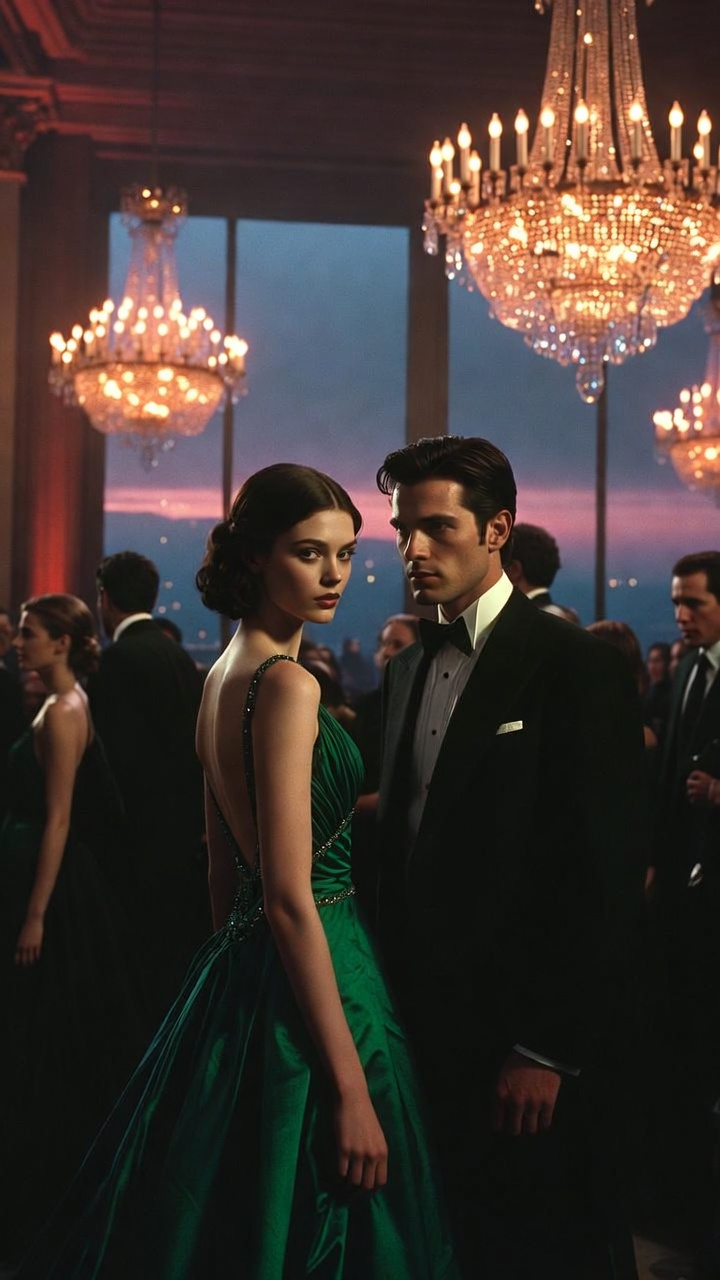
The grand ballroom of the Hôtel de Crillon was alive with the low hum of old money and new ambition. Crystal chandeliers dripped warm golden light over black ties, emerald gowns, and the soft clink of Baccarat glasses. It was the annual Fondation Lumière gala—charity for orphaned artists, naturally—and every corner smelled of tuberose, aged Bordeaux, and quiet power plays.
Élise stood near the marble fountain, her white silk ball gown catching the light like fresh snow. The dress had been her grandmother’s, restored thread by thread over six months by a couturier in the Marais. Long braided hair cascaded down her back, a single strand of pearls at her throat. She held no glass tonight. She rarely did anymore.
Across the room, Victor Langlois—forty-two, heir to a shipping fortune, perpetual smirk—watched her. He had spent the evening circling, making small talk with board members while keeping her in peripheral vision. Tonight was the night he would remind her, publicly, of her place.
He approached with deliberate slowness, a full glass of 2015 Château Margaux in hand. The crowd parted slightly, sensing theater.
“Élise,” he said, voice smooth as oiled leather. “You look… almost respectable.”
She met his eyes. No smile. No flinch.
He raised the glass in mock toast.
“To second chances,” he said loudly enough for nearby heads to turn. “And to those who don’t deserve them.”
Then he tipped the glass.
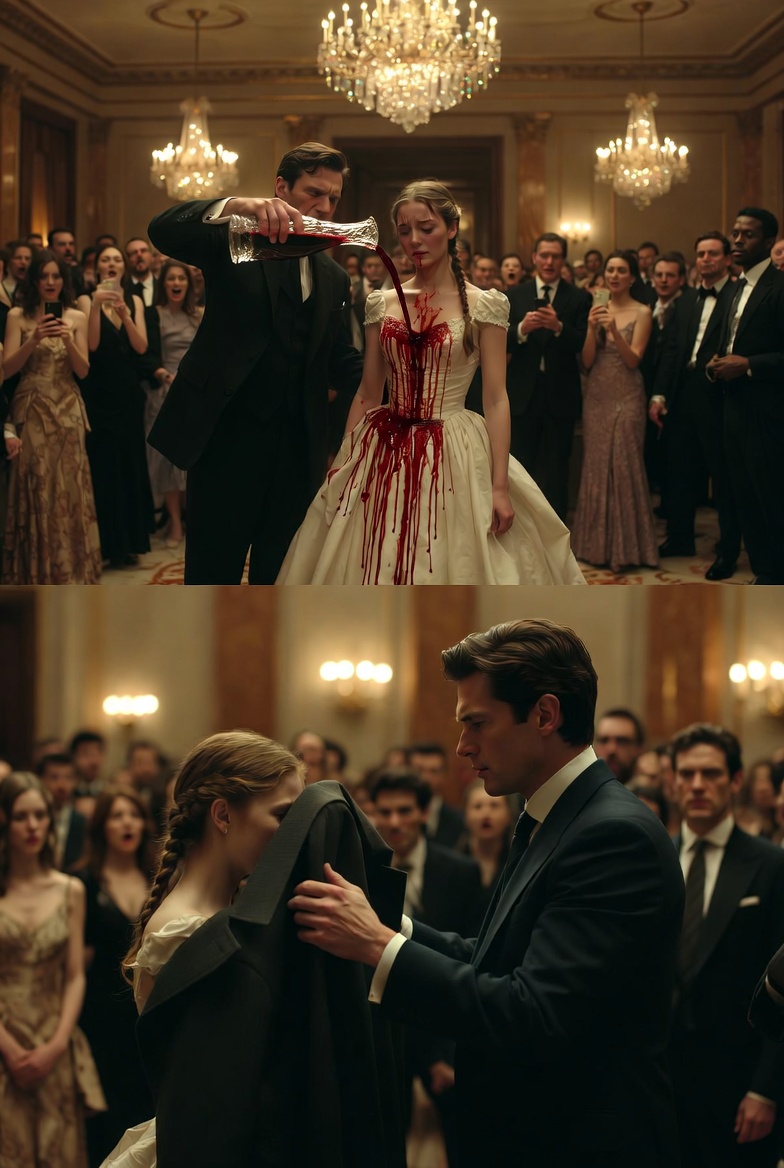
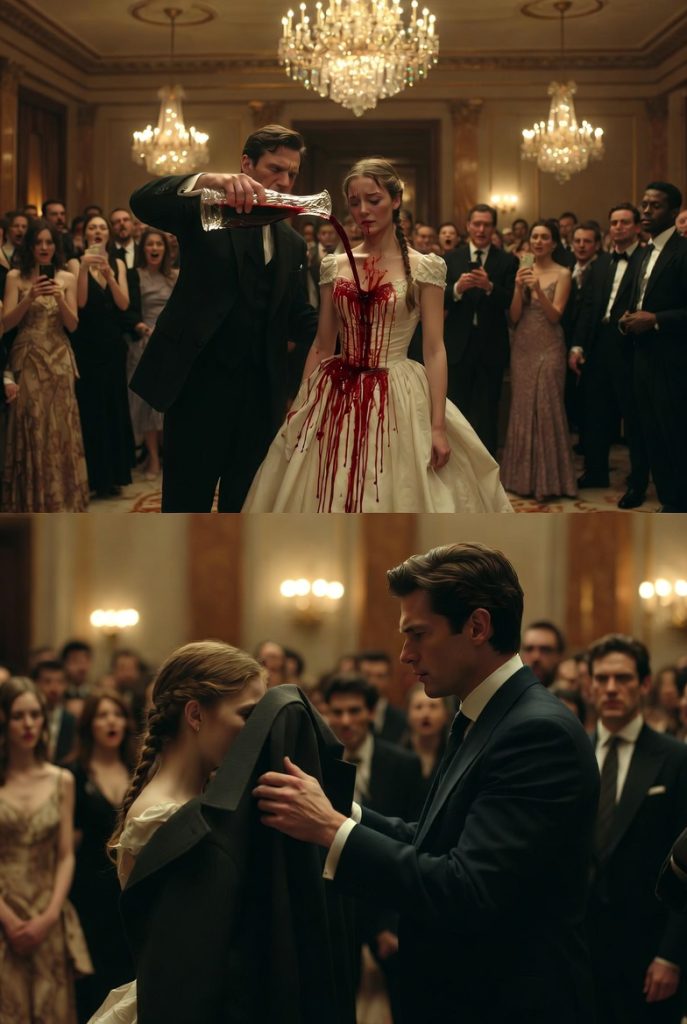
The red wine poured in a slow, deliberate arc. It hit the bodice first—dark crimson blooming across the pristine silk like blood on frost. Then it ran in rivulets down the skirt, soaking lace, staining tulle, pooling at her silver heels. The fabric drank it greedily; the white turned ruined rose in seconds.
A hush fell over the nearest circle. Gasps. Phones lifted discreetly. Someone whispered “Mon Dieu.”
Élise did not move. Her chin stayed level. Her hands remained at her sides. Only her eyes changed—deep brown pools filling with something ancient and quiet: not rage, not shame, but a bone-deep sadness, the kind that comes after years of expecting exactly this.
Victor stepped back, satisfied, swirling the last drops in his glass.
“Oops,” he said to the crowd. “Clumsy me.”
A ripple of uneasy laughter.
Then a new figure cut through the spectators.
Tall, broad-shouldered, dark navy suit tailored sharp enough to draw blood. Alexandre Duval—art dealer, silent partner in half the galleries in Paris, and the only man in the room who had known Élise since she was seventeen and sleeping on friends’ couches after her family lost everything.
He carried a slim leather dossier under one arm—contracts for the foundation’s next auction. In his other hand, nothing at first.
He stopped beside her without a word. The crowd watched, phones still raised.
Alexandre looked once at the stain, once at Victor—long enough for Victor’s smirk to falter—then shrugged off his charcoal-gray overcoat. Cashmere, lightweight, perfectly cut.
He draped it over Élise’s shoulders with the gentleness one uses on something fragile and irreplaceable. The coat settled like armor, covering the worst of the damage, the gray wool absorbing stray droplets without complaint.
He leaned in, voice low, English for privacy amid the French murmurs:
“You’re still the most beautiful thing in this room.”
Élise’s lips trembled—just once—before she pressed them together. She pulled the coat tighter, breathing in the faint scent of cedar and him.
Victor cleared his throat, trying to reclaim the moment.
“Really, Duval? Playing knight for the charity case?”
Alexandre turned fully toward him. No raised voice. No drama.
He opened the dossier with one hand, extracted a single sheet, and held it out.
“Article 7.2 of the foundation bylaws,” he said calmly. “Any donor found to have deliberately damaged another guest’s property during an event may have their contribution revoked and their name removed from all future acknowledgments. Permanently.”
Victor’s face drained of color.
“That’s—preposterous. It was an accident.”
Alexandre tilted his head.
“Was it?”
He let the question hang. Then, softer:
“Security has already pulled the hallway cameras. They’re very clear.”
Victor’s glass trembled. He set it on a passing tray with too much force.
The phones were still recording. The crowd had gone completely silent now—no laughter, no whispers, only the soft orchestral strings from the string quartet in the corner.
Alexandre turned back to Élise.
“Shall we leave, or would you like dessert first?”
She looked up at him. The sadness in her eyes had shifted—not gone, but edged with something steadier.
“Dessert,” she said quietly. “I’ve earned it.”
He offered his arm. She took it.
As they walked past Victor—past the frozen clusters of guests, past the glittering chandeliers—Élise paused for half a second.
Without turning, in perfect, clear English that carried farther than she intended:
“Thank you for the wine, Victor. It matches your personality perfectly.”
A few stifled laughs broke the tension. Someone clapped—slow, solitary—then another.
Victor stood alone in the center of the stain’s reflection on the marble floor, glass empty, smirk gone.
Élise and Alexandre continued toward the dessert table. The gray coat stayed on her shoulders like a promise.
Outside, later, under the Paris night sky, she would finally let the tears fall—not from humiliation, but from the quiet relief of not being alone anymore.
For tonight, at least, the white dress was ruined.
But she was not.
End.


About The Author