The Silence Before the Deluge
The Silence Before the Deluge
The Amalfi Coast had always felt like a place borrowed from time. Lemon groves clung to cliffs that plunged straight into turquoise water; pastel villages balanced impossibly on slopes too steep for reason. Thomas and Julia had come here to remember what life felt like before deadlines, before mortgage payments, before the slow erosion of small daily disappointments. They were thirty-eight and thirty-six, childless by choice, still in love in the quiet, stubborn way that survives ten years of marriage. This was their first real holiday in four years.
They had rented a small suite at the Hotel Santa Caterina, perched high above the sea in Amalfi proper. The room opened onto a private terrace with an infinity pool that seemed to spill directly into the Mediterranean. That afternoon—July 12, 2026—they sat on striped lounge chairs, skin warm from the sun, reading and sipping chilled Falanghina. Julia wore a wide-brimmed hat and a linen dress the color of sea glass. Thomas had a sketchbook open on his lap; he was an architect, and even on holiday he could not stop drawing—quick studies of arches, balconies, the way light fractured on water.
The sea was mirror-flat. No wind. No waves. Only the soft lapping at the rocks far below and the distant putter of a fisherman’s outboard.
Then the water simply left.
It happened without warning and without sound.
One moment the bay was full; the next, the horizon line dropped. Water receded in a single, impossibly smooth motion—hundreds of meters in seconds—leaving boats stranded on their sides, hulls exposed like beached whales. Fish flopped helplessly on wet sand. Octopuses crawled across rocks that had not seen daylight in centuries. The seabed lay naked: dark ridges of ancient reef, drowned stone walls, rusted anchors half-buried in silt.
Julia lowered her book. “Thomas…”
He was already standing. The architect in him recognized the geometry of disaster instantly.
“Tsunami precursor,” he said, voice flat with certainty. “The withdrawal. We have maybe three minutes.”
Julia didn’t question him. She never did when he spoke like that—calm, clinical, already calculating escape vectors. She grabbed the small daypack they kept by the door: passports, phones, wallets, water bottles, a first-aid kit. Thomas snatched the hotel bathrobes—thick terrycloth, useless for warmth but better than nothing against abrasion—and the two beach towels.
They ran barefoot down the corridor. The hotel was quiet; most guests were still at the beach or napping. A maid pushing a cart looked up in confusion as they sprinted past.
“Up!” Thomas shouted at her in Italian. “Upstairs! Now!”
She stared, bewildered.
He didn’t have time to explain.
They reached the stairwell. Fourth floor. Fifth. The building was old, stone and wrought iron, built into the cliff itself. The stairs were narrow, the railings cool under their palms.
At the fifth-floor landing they burst onto an open terrace—a restaurant with white tablecloths and half-finished lunches. A waiter froze with a bottle in his hand.
“Get everyone upstairs!” Thomas yelled. “The sea is coming!”
The waiter blinked.
Julia grabbed his arm. “Tsunami. Move!”
Something in her face—raw panic held in check by will—finally broke through. The waiter dropped the bottle and began shouting for the kitchen staff.
Thomas and Julia kept climbing.
Sixth floor. Seventh. The top level was mostly suites and a rooftop bar. They pushed through a service door onto the open roof terrace.
From here they could see everything.
The horizon was no longer water. It was white.
A wall—miles long, hundreds of feet high—rose in perfect, terrifying silence. Boats, buoys, pieces of dock floated upward like toys in a bathtub, then vanished as the wave curled over itself. The leading edge was already frothing, carrying debris: umbrellas, sunbeds, entire beach bars ripped from their moorings.
Julia clutched Thomas’s arm. “How high will it come?”
He stared at the cliff line below. The hotel sat 120 meters above sea level. The wave was still growing.
“I don’t know,” he said honestly. “But we’re as high as we can get.”
They wrapped the towels around their wrists and tied them to the wrought-iron railing—thin protection, but better than nothing. Thomas pulled Julia against the concrete service hut, the sturdiest structure on the roof. They sat, backs to the wall, knees drawn up.
The silence was absolute.
No roar yet. Only the soft hiss of displaced air and the distant scream of metal twisting far out at sea.
Julia pressed her forehead to his shoulder. “If we don’t make it—”
“We will,” he said, though he wasn’t sure.
Then the sound arrived.
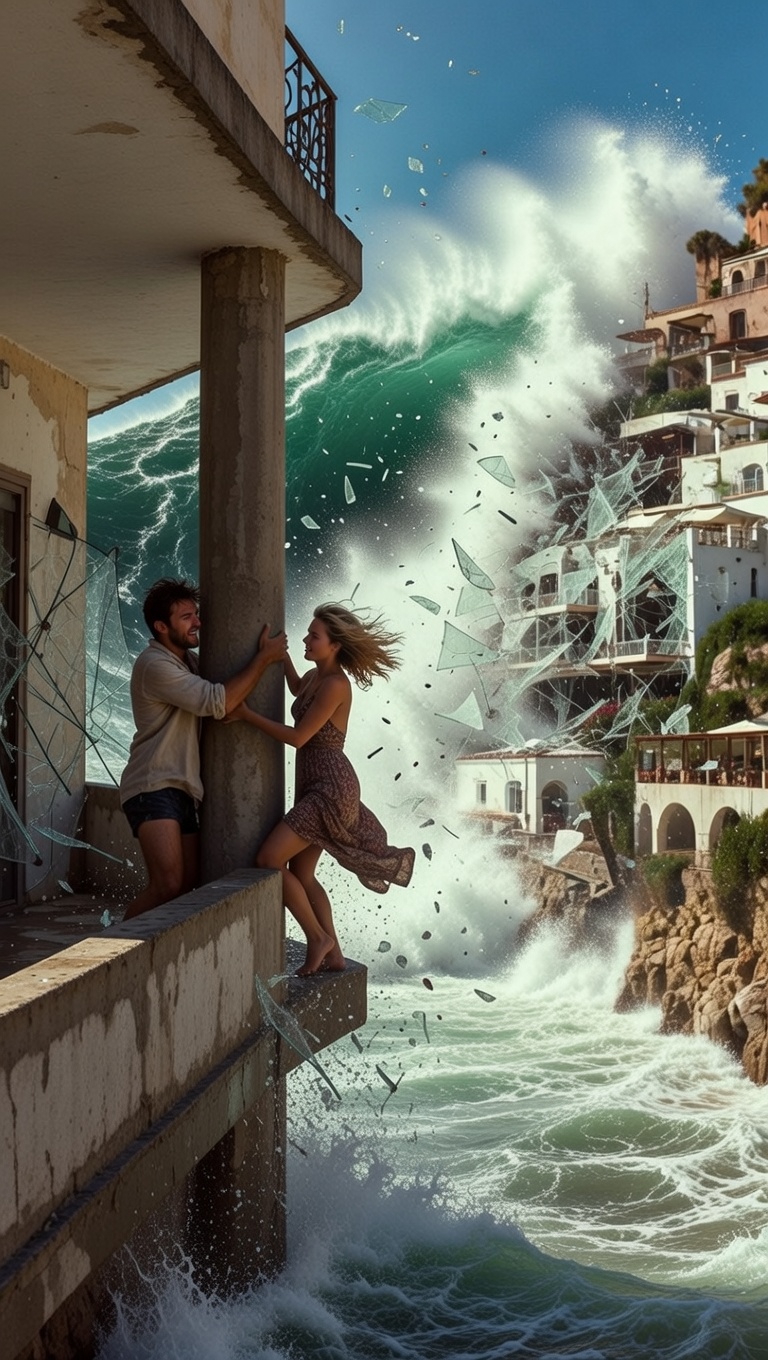
It began as a low vibration in the chest—felt before heard—then rose into a continuous, world-ending roar. The wave hit the lower town first. Buildings folded like cards. Cars spun end over end. The noise was physical: glass exploding, stone cracking, wood splintering, all of it compressed into one unending bellow.
The hotel shook.
Thomas wrapped both arms around Julia. She buried her face against his neck. The wave climbed the cliff below them—faster than anything that massive should move—carrying roofs, trees, entire floors of hotels. Debris smacked the lower terraces; water exploded upward in white geysers.
Then it reached them.
The crest was higher than the roof. For one endless second they saw it coming—green-black water laced with foam and wreckage, boats tumbling inside it like dice in a cup.
The impact was cataclysmic.
The building lurched. Concrete screamed. The railing bent inward. Water slammed across the roof in a horizontal avalanche, tearing chairs, umbrellas, planters away in one second. Thomas and Julia were lifted, slammed against the service hut, dragged across the tiles. The towels around their wrists tore but held. Water filled their mouths, their noses, their lungs.
They did not let go of each other.
The first wave passed.
The second came lower, weaker, retreating almost as fast as it had arrived.
They were still on the roof.
Coughing, gasping, tangled in rope and splintered wood, they clung to the railing. The terrace was gone—scoured clean. Below, the town had vanished. Where pastel houses and crowded streets had stood, there was only churning brown water studded with floating wreckage.
Julia lifted her head. Her face was streaked with blood from a cut on her temple. She looked at Thomas.
He was staring at the horizon.
The sea was already pulling back again—preparing for the next surge.
But this time they were ready.
Thomas untied the shredded towels from their wrists. He took Julia’s hand.
“Stay with me,” he said.
She squeezed back.
They waited.
The second wave came—smaller, slower, exhausted.
It washed across the roof, knee-deep, then waist-deep, then receded.
And did not return.
The silence that followed was different from the one before. It was the silence of aftermath: dripping water, creaking metal, distant cries. The sky cleared to merciless blue.
Thomas helped Julia to her feet.
They stood on the ruined roof, looking down at what was left.
The Hotel Santa Caterina still stood—battered, gutted, but standing.
The town below was gone.
They were alive.
Julia leaned against him, trembling.
Thomas kissed the top of her head.
“Next time,” he whispered, “we stay inland.”
She laughed—a short, broken sound that turned into a sob.
They held each other as the sun climbed higher, burning away the last of the mist.
Below, the sea returned to its cradle, quiet now, as though nothing had happened.
But the scars would remain.
And so would they.

About The Author