48 Hours in Hell
48 Hours in Hell
Clara Moreau had always preferred the deep to the shallows. At thirty-one, she was already one of the most experienced technical divers in Marseille—certified for rebreathers, cave penetration, saturation diving. She trusted her gear, her training, and—most of all—herself. That was why, on a clear October morning in 2025, she decided to do something she had never done before: a solo dive on the outer edge of the Gulf of Lion, far beyond the usual tourist sites.
No buddy. No boat captain waiting topside. Just her, her twin-set tanks, a scooter, and the promise of virgin wrecks untouched since the war.
She launched from a rented 7-meter RIB at 06:45. The sea was glass. She motored twenty-two nautical miles south-southwest to a GPS waypoint she had marked months earlier: a decommissioned oil platform, code-named Delta-7, abandoned in 1998 after a blowout and never properly dismantled. Official charts listed it as a navigational hazard, but Clara had heard rumors—intact interiors, flooded corridors, maybe even a decompression chamber still pressurized. A diver’s dream.
She tied the RIB to one of the platform’s rusted mooring cleats, clipped her scooter to her BCD, and slipped over the side at 07:12.
The water was 19 °C and gin-clear. She descended along the leg of the platform, following the massive steel pillar down into blue twilight. At thirty meters the light began to fade. At fifty she switched on her primary video light. The platform’s underbelly loomed above her like the ribcage of a drowned giant—cross-bracing, anodes, colonies of mussels. She tied off her scooter at the -60 m mark and began her penetration.
The first few hours were perfect.
She glided through flooded pump rooms, past rusted valves the size of small cars, through corridors where cables still hung like black seaweed. Her rebreather exhaled only bubbles so small they vanished almost instantly. No noise except her own slow heartbeat and the metallic creak of the structure settling in the current.
She found the decompression chamber on the third level—intact, door ajar, pressure gauge frozen at 4 bar. She filmed everything. This was going to be her best footage yet.
At 11:47 she began her ascent.
That was when she realized the RIB was gone.
She surfaced inside the platform’s moonpool—a rectangular opening in the deck where supply boats once docked. The water was flat, oily. No boat. No mooring line. The cleat she had tied to was still there, but the rope had been cut clean.
Panic arrived in stages.
First: disbelief. She swam the perimeter of the moonpool, calling out. Nothing answered except echoes.
Second: calculation. The platform was sixty-five nautical miles from the nearest land. No VHF radio on her person—left in the boat. No EPIRB. No PLB. She had trusted the boat to be her surface safety.
Third: cold math. She had twelve hours of bailout gas left in her twin-set. The platform had no fresh water, no food, no shelter from the sun or wind. October nights in the Gulf of Lion dropped to 8 °C. Hypothermia would arrive long before dehydration.
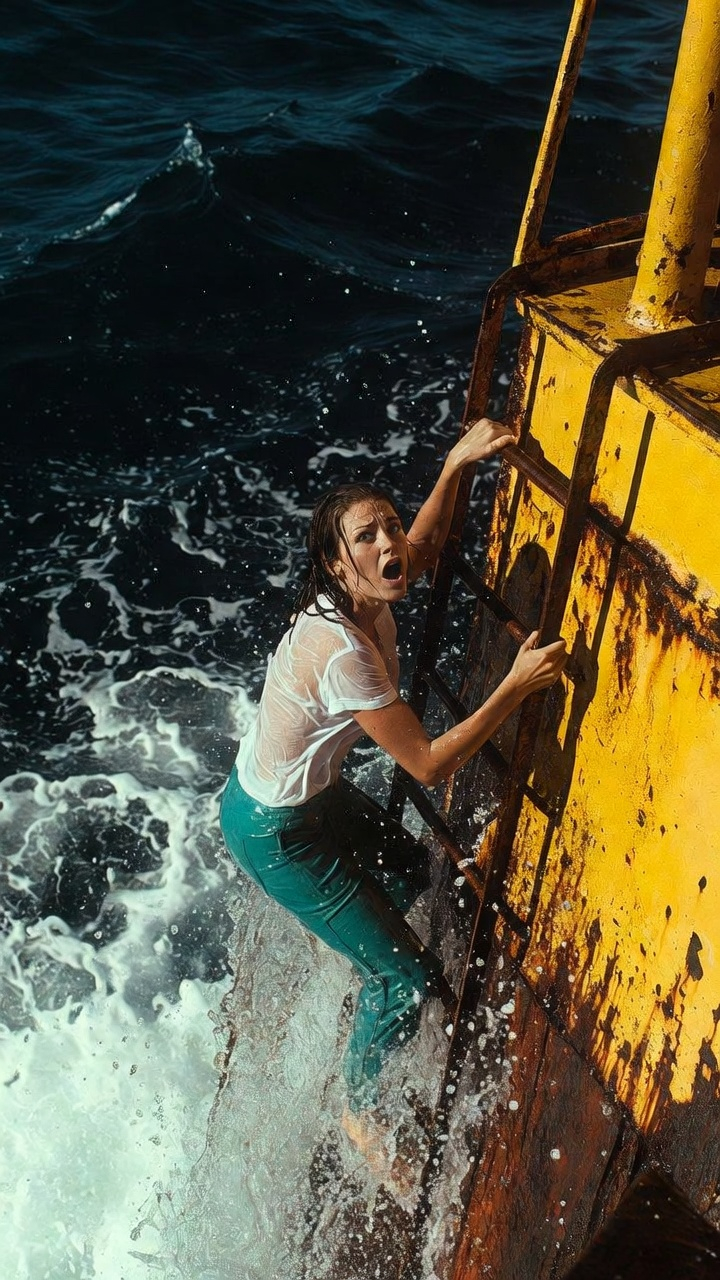
She climbed the rusted ladder to the main deck.
The platform was larger than she expected—three levels above water, catwalks, cranes frozen in mid-motion, a control room with shattered windows. She found a small operations shack with a few lockers. Inside: a half-empty bottle of mineral water (probably ten years old), a rusted flare gun with two cartridges, a survival blanket made of foil, and a faded company handbook.
She drank one swallow of the water. It tasted of iron and plastic.
Then she saw the fin.
A single black dorsal, slicing the surface two hundred meters out, circling clockwise. The shark was big—six meters at least. A great white. It had probably followed the scent of her exhaust bubbles or the metallic tang of her gear from kilometers away.
Clara watched it for twenty minutes. It never deviated from its pattern. Patient. Methodical.
She knew the statistics: great whites rarely attack humans unprovoked. But they also rarely encountered a human alone, bleeding from minor cuts, exhausted, trapped on a metal island surrounded by deep water.
She spent the first night in the control room, wrapped in the foil blanket, back against a console. She rationed the water—one sip every three hours. She talked to herself in whispers—narrating what she was doing as though recording a log.
“Hour fourteen. Shark still circling. No rescue signal possible. Tomorrow I try the radio room on the upper deck. Maybe the emergency beacon is still functional.”
Dawn came grey and cold. The shark was closer—fifty meters now. It rolled on its side once, showing the white belly, a silent threat display.
Clara climbed to the radio shack. The equipment was twenty-five years old, panels cracked, but the emergency beacon—a yellow EPIRB mounted on the roof—looked intact. She pried it free, pulled the antenna, pressed the activation button.
Nothing. No strobe. No beep. The battery was dead.
She screamed—once, raw, useless—then clamped her mouth shut. Sound carried over water.
By noon the thirst was unbearable. She licked condensation from the inside of a broken window. It tasted of rust and salt.
The shark had company now. A second dorsal—smaller, probably a juvenile—joined the patrol. They circled in tandem, tighter orbits.
Clara realized something terrible: the platform’s legs were encrusted with barnacles and algae. The shark could smell blood from any cut, any abrasion. And she had several—scraped knuckles, a shallow gash on her shin from the ladder.
She tore strips from the survival blanket, wrapped her wounds. Then she found an old fire axe hanging in a bracket. The handle was rotten, but the head was still solid.
She carried it everywhere.
Night two.
She sat on the roof under the stars, axe across her knees. The shark had moved directly beneath the platform, bumping the steel legs with deliberate thuds. Each impact rang through the structure like a gong.
Clara began to talk to it.
“You’re waiting for me to fall,” she whispered. “I won’t.”
She sang softly—old Provençal lullabies her grandmother used to sing. The sound was small, but it kept her mind tethered.
At 03:17 she heard propellers.
Distant at first—then louder.
A searchlight swept the horizon. A Coast Guard patrol boat.
Clara stood. She loaded the flare gun with trembling hands, pointed it skyward, and fired.
Red light arced across the night, bursting into a brilliant parachute flare that hung above the platform like a second moon.
The boat altered course.
The shark vanished instantly—diving deep, disappearing into the black.
Forty minutes later, the patrol boat came alongside. A Zodiac launched. Strong hands pulled her aboard.
She collapsed on the deck, wrapped in a thermal blanket, shaking so hard her teeth chattered.
A medic pressed warm water to her lips.
“You’re safe,” he said.
Clara looked back at the platform—silent now, empty, waiting for the next fool who thought the sea could be trusted.
She closed her eyes.
She had survived forty-eight hours in hell.
And the shark had simply gone home.


About The Author