The Quiet One
The Quiet One
Everyone at Victor Hugo High called him “Binoclard.”
Léo Moreau, sixteen, thin wrists, thick black glasses, always the last one picked for teams, always the one carrying extra books for teachers, always the one who looked away when someone laughed too loud. The nickname had started in middle school and stuck like gum under a desk. He never corrected anyone. He never fought back. He just adjusted his glasses and kept walking.
Most days that was enough to stay invisible.
Not today.
It was the last Friday before the Christmas break. The central courtyard was packed—students spilling out of classrooms, phones already recording, the air buzzing with end-of-term energy. Léo was heading toward the library with a stack of physics textbooks when Jérémy “Jéjé” Duval decided to make an example of him.
Jérémy was the undisputed king of the senior class: captain of the football team, six-foot-one, shoulders like a billboard, smile that got him out of detentions. He had a reputation for “keeping order”—which mostly meant picking on whoever looked easiest.
Léo walked past the fountain. Jérémy stepped into his path.
“Hey, Binoclard,” Jérémy called, loud enough for half the courtyard to turn. “You forgot to pay the toll.”
Léo stopped. Adjusted his glasses. Said nothing.
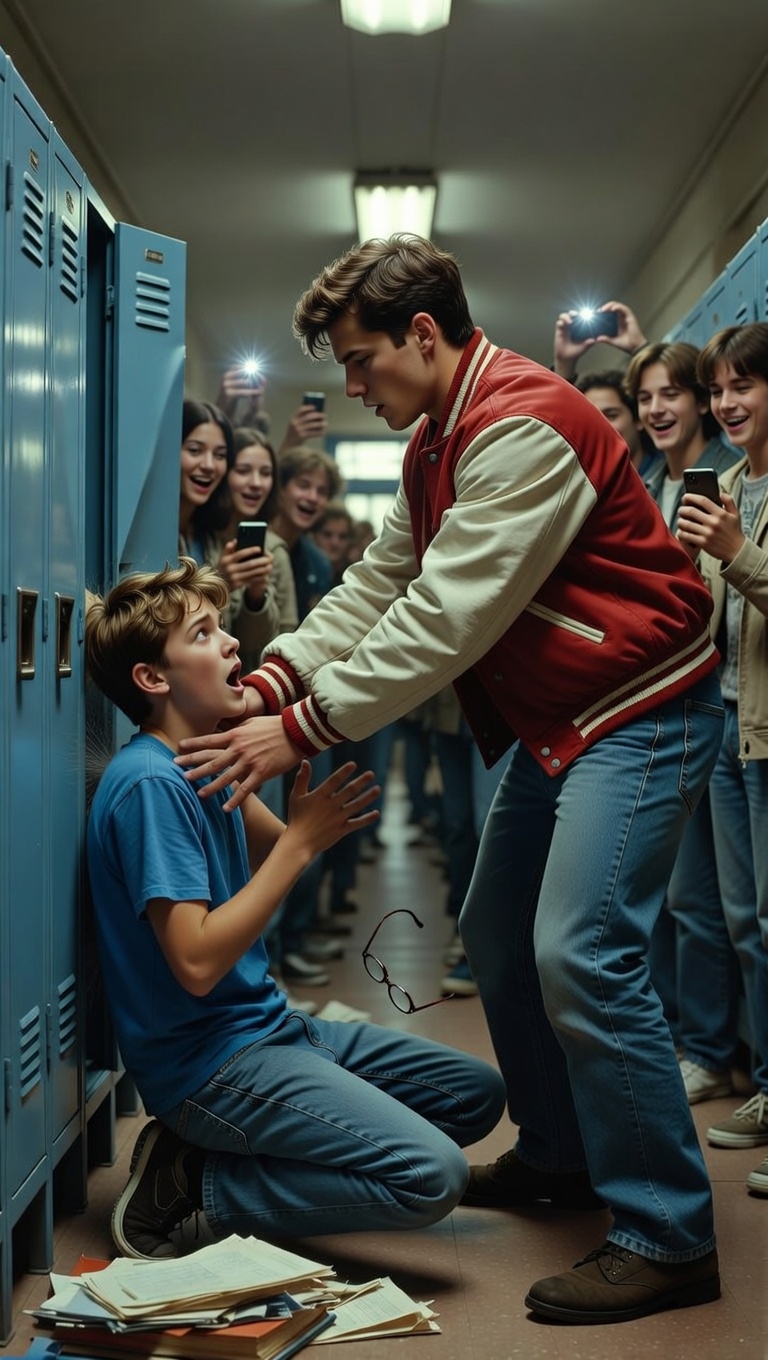
Jérémy grinned wider. He grabbed Léo’s backpack strap and yanked him forward, slamming him chest-first against the row of metal lockers with a metallic clang that echoed off the concrete walls.
The crowd formed instantly—phones up, laughter rising.
Jérémy leaned in close. “You look at me when I talk to you, four-eyes.”
Léo’s glasses slid down his nose. One lens cracked against the locker door.
He didn’t blink.
Jérémy laughed, turned to the crowd for approval, then shoved Léo harder—hard enough that the backpack fell, books spilling across the tiles.
That was when something changed.
Léo slowly straightened. He reached up, removed his broken glasses, folded them carefully, and placed them in his hoodie pocket.
The laughter thinned.
Jérémy noticed the shift too late.
Under the baggy hoodie sleeves, Léo’s forearms were wrapped in faded athletic tape—black, professional-grade, the kind used to protect knuckles and wrists during full-contact sparring. The tape was worn, frayed at the edges, stained with old sweat and older blood.
He rolled his shoulders once—small, almost imperceptible.
Then he looked up.
The boy who had been Binoclard was gone.
In his place stood someone else—someone who had spent three years training five days a week in a basement gym on the outskirts of Paris. Someone who had won silver at the French national MMA championships in the -66 kg category last spring. Someone who had chosen silence not because he was afraid, but because he had nothing left to prove.
Jérémy sensed it. He squared up anyway—chest out, fists loose, still believing size and reputation were enough.
“Whatcha gonna do, nerd?” he sneered.
Léo answered with movement.
He stepped inside Jérémy’s reach—fast, fluid, no telegraph—and snapped a short, vicious jab into the solar plexus. The punch was surgical: not to knock out, just to fold the diaphragm and steal the air. Jérémy’s eyes widened; his mouth opened in a silent O.
Before he could recover, Léo pivoted on his lead foot and threw a tight right hook that caught Jérémy flush on the jaw. The crack was sharp, clean. Jérémy’s head snapped sideways. His knees buckled.
The courtyard went quiet.
Léo didn’t stop.
He slipped under Jérémy’s instinctive grab, hooked an arm, twisted his hips, and executed a perfect hip throw. Two hundred pounds of football muscle hit the concrete with a thud that knocked the breath out of everyone watching.
Jérémy tried to rise.
Léo stepped on his wrist—lightly, just enough pressure to pin it—and looked down.
“You done?” he asked. Voice calm. Almost polite.
Jérémy wheezed. Tried to swing with his free hand.
Léo caught the wrist mid-arc, twisted it into an armbar, and rolled. Jérémy tapped the ground frantically.
Léo released him instantly and stood.
The crowd was frozen. Phones still recording, but no one laughed. No one cheered. They just stared.
Léo picked up his broken glasses, dusted them off, slipped them back on even though one lens was spiderwebbed. He looked around at the faces—some shocked, some frightened, some quietly impressed.
“I didn’t want to fight,” he said, loud enough to carry. “I just wanted to be left alone.”
He turned to Jérémy, who was still on the ground holding his jaw.
“Next time you need to feel big, pick on someone who wants the attention.”
He shouldered his backpack, stepped over the spilled books, and walked toward the library doors.
The crowd parted without being asked.
Behind him, Jérémy stayed down.
By Monday morning the video was everywhere—shared, reposted, dissected. The hashtag #BinoclardNoMore trended in France for three days.
Teachers started looking at Léo differently. Students stopped using the nickname.
And in the gym at lunch, when someone asked him to join the pickup basketball game, Léo just smiled—small, quiet—and said:
“Maybe next time.”
He never needed to prove anything again.
Because the shadow champion had finally stepped into the light.
And no one would forget what happened when he did.

About The Author