
The Game of Death
The Game of Death
Marc had always been good at planning.
He planned the wedding in Capri because it looked perfect in photos. He planned the prenup because love was temporary but assets were forever. He planned the yacht trip to celebrate their tenth anniversary because Elena loved the sea — and because the Mediterranean was deep enough to hide mistakes.
He had not planned for Elena to survive.
The yacht — a sleek 62-foot Sunseeker named Liberté — cut through the water south of Corsica at 28 knots. The sun was low, bleeding orange across the horizon. Elena had gone below to change into her swimsuit. Marc had waited until she emerged on the swim platform, smiling, arms open to the wind.
“Race you to the buoy?” she called.
Marc laughed — the practiced laugh he used when he wanted her to feel safe.
“You’re on.”
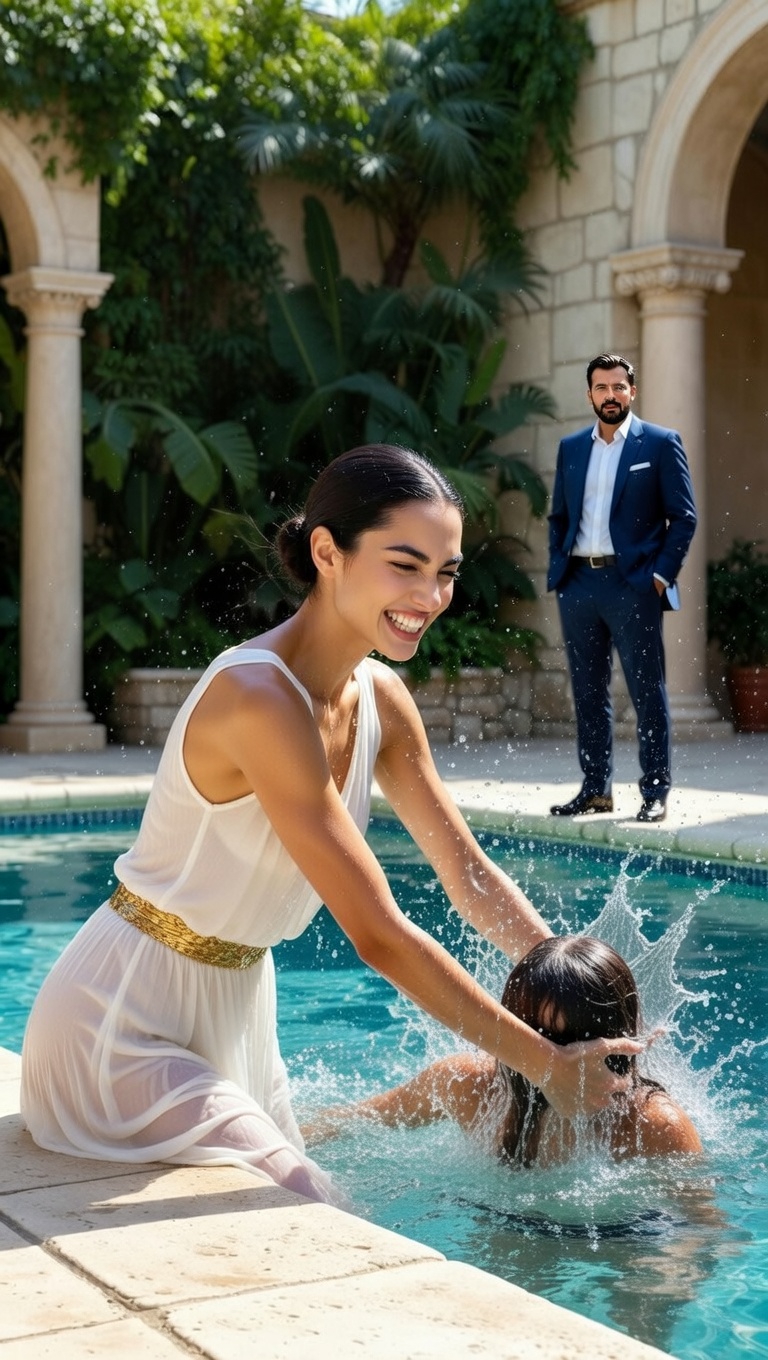
He throttled up just enough to pull ahead. Elena dove cleanly, arms slicing the water, body arrow-straight. She was a former French national freediving champion — three national records in breath-hold depth before she retired at twenty-four to marry him. He had always found it charming. Useful, even. A woman who could hold her breath for seven minutes was a woman who could be trusted not to panic.
He waited until she was fifty meters out.
Then he cut the engines.
The yacht slowed, drifted.
Elena surfaced, treading water, laughing.
“Cheater! You’re supposed to wait for the start!”
Marc leaned over the rail, smiling down at her.
“You always were faster in the water.”
He reached into the console drawer, pulled out the small black box he had hidden there for three weeks.
A remote kill switch.
One press — the engines died completely. No restart. No power. The yacht became a drifting white coffin.
Elena’s smile faded.
“Marc?”
He didn’t answer.
He pushed the throttle forward — just enough to send the boat gliding away from her at idle speed.
Elena began to swim after it — strong, efficient strokes.
Marc watched her for a moment.
Then he walked to the stern, opened the lazarette, and pulled out the small inflatable dinghy he had prepared. He inflated it in thirty seconds, dropped it over the side, climbed in, and motored away at full throttle toward the distant coastline of Sardinia.
Behind him, Elena realized.
She stopped swimming.
She floated, watching the yacht grow smaller, watching her husband disappear into the dusk.
She did not scream.
She did not cry.
She breathed — deep, slow, controlled — the way she had been trained.
Then she turned toward the horizon.
And she swam.
She swam through twilight into night.
The water was 19 °C — cold enough to steal heat, not cold enough to kill her quickly. She paced herself: long, gliding strokes, face down, exhaling slowly through her nose to conserve oxygen. Every ten minutes she rolled onto her back, floated for thirty seconds, looked for lights, for ships, for anything.
Nothing.
Only stars. Only black water. Only the slow rhythm of her own heart.
She thought of Camille — their six-year-old daughter — waiting at the villa in Bonifacio. Marc had told her “Maman’s just doing a long swim.” He had kissed Camille’s forehead, promised ice cream when he returned.
He would return alone.
He would tell Camille her mother had drowned — tragic, accidental, no body recovered because the current was too strong.
He would inherit everything: the villa, the investments, the trust her father had set up in Elena’s name. He would grieve publicly. He would be pitied. He would be rich.
Elena felt the cold seep deeper — into her fingers, her core. Her strokes grew slower. Her lungs burned.
She pushed on.
At hour seven she began to hallucinate — lights dancing on the water, voices calling her name. She ignored them. She counted strokes instead. One thousand. Two thousand. Three thousand.
At hour nine her right calf cramped so badly she nearly screamed. She floated on her back, massaging the muscle under water, breathing through the pain.
She thought of Camille again — the way she laughed when Elena blew raspberries on her stomach, the way she asked impossible questions about stars.
Elena rolled over.
She swam.
At hour eleven she saw it: a faint red blinking light on the horizon.
A buoy.
She aimed for it.
Every stroke cost more than the last. Her vision narrowed to a tunnel. Her arms felt like lead pipes.
She reached the buoy at hour twelve and forty-three minutes.
She draped her arms over the chain, let her body hang, rested her cheek against cold steel.
She cried then — silent, exhausted tears that mixed with seawater.
She did not know if anyone would find her.
She did not know if Marc had already told Camille she was dead.
But she knew one thing.
She was alive.
And she was coming home.
Three days later, a Tunisian fishing trawler spotted her — clinging to the buoy, sunburned, dehydrated, barely conscious.
They pulled her aboard.
They gave her water.
They radioed the coast guard.
By the time she reached the hospital in Ajaccio, her story was already spreading — the woman who swam twelve hours after her husband tried to murder her at sea.
Marc was arrested at the villa in Bonifacio.
He had told Camille her mother was “lost at sea.”
He had already begun transferring funds.
He had not expected Elena to walk through the front door three days later — gaunt, bandaged, but alive.
He had not expected the police to be waiting.
He had not expected Camille to run to her mother and sob, “You came back.”
Elena looked at him over her daughter’s head.
She did not scream.
She did not cry.
She simply said — in a voice calm enough to cut glass:
“You should have made sure I was dead.”
The trial lasted nine months.
The evidence was overwhelming: the remote kill switch, the forged distress beacon log, the emails to his lawyer discussing “the problem at sea.”
He was sentenced to twenty-five years.
Elena kept the house in Bonifacio.
She kept the yacht — renamed Survivante.
She taught Camille how to swim — long, slow strokes, face in the water, breathing controlled.
And every year on July 3 — the anniversary of the night she was supposed to disappear — they sailed out to the spot where the buoy had been.
Elena would drop a single white rose into the water.
Then she would look at her daughter and say:
“Remember, ma chérie: the sea is deep, but it cannot hold you unless you let it.”
Camille would nod.
And they would swim.
Together.
Strong.
Alive.


About The Author