The Crystal Trap
The Crystal Trap
Léa and Marc had dreamed of this place for years.
A sleek, modern chalet perched on a south-facing ridge in the French Alps, near Les Contamines-Montjoie. Floor-to-ceiling triple-glazed panels replaced entire walls, turning every room into a panoramic window onto snow-laden pines and distant peaks. Solar panels, geothermal heating, smart-glass that tinted on command, automated shutters rated to withstand avalanche-grade winds—the architect had called it “a sanctuary of light and safety.” They had moved in three weeks earlier, just before the first heavy snow of December 2025.
They were still unpacking boxes when the storm arrived.
It began as a postcard: fat flakes drifting past the glass while a fire crackled in the linear hearth. Léa, 34, a freelance photographer, stood barefoot on the heated slate floor, camera in hand, capturing the way the light fractured through falling snow. Marc, 37, a software engineer who had finally sold his startup for enough to retire early, poured two glasses of Bordeaux and smiled at her over the rim.
“Worth every euro,” he said.
Then the power flickered.
Not a full blackout—just a stutter. The recessed LEDs dimmed, brightened, dimmed again. The smart-home panel on the wall blinked red: System Rebooting – 47%. The motorized shutters, designed to drop automatically during power loss, stayed open. The house’s backup battery, supposed to bridge any outage, didn’t engage.
Marc frowned. “That’s not right.”
He tapped the panel. No response. He opened the breaker cupboard in the utility room. Everything looked normal—green lights, no tripped switches. Outside, the wind had risen to a low moan.
Léa joined him at the window. “Maybe the solar feed is iced over. We’ll call the installer tomorrow.”
They returned to the living room. The fire still burned, but the room felt colder. The glass walls, so beautiful in daylight, now turned the chalet into a brightly lit stage set against the black forest. They were on display.
Marc noticed it first.
A pair of yellow eyes reflecting the firelight.
Then another. And another.
They appeared one by one along the tree line, fifty meters downslope—silent, motionless, watching. Dozens of them. The snow around their paws was churned into dirty paths; they had been circling for hours.
Léa’s breath caught. “Marc…”
He moved to the control panel again, stabbing buttons. Nothing. The shutters remained up. The exterior floodlights—supposed to deter wildlife—stayed dark.
A low rumble rolled through the glass. Not thunder. A growl, deep enough to vibrate the floor.
The lead wolf stepped forward.
It was enormous—easily 180 pounds, black as wet ink, shoulders higher than a Great Dane’s. Scars crisscrossed its muzzle; one ear was torn halfway off. It walked straight to the nearest pane, rose on hind legs, and placed both forepaws against the glass.
The triple glazing flexed inward—barely a millimeter, but enough for Léa to see the distortion.
Marc grabbed her wrist. “Back away from the windows.”
They retreated to the center of the room. The wolf pressed harder. A faint crackle sounded—hairline fractures spidering outward from the points of contact. Behind it, the rest of the pack advanced in a loose semicircle. No howling. No barking. Just deliberate, coordinated pressure.
Léa’s voice was barely audible. “They’re testing the glass.”
Marc ran to the utility room, yanked open the emergency locker. Inside: a flare gun, two highway flares, a tactical flashlight, and the satellite phone they kept for emergencies. No gun—French law made owning one in a private residence complicated. He cursed under his breath.
The first real crack split the air—sharp, like ice breaking on a lake. A long vertical line raced up the center pane.
Marc rushed back. “We need to kill the interior lights. They’re drawing them.”
He flipped every switch he could reach. The room plunged into near-darkness, lit only by the dying fire. For a moment the yellow eyes outside seemed to dim, confused.
Then the lead wolf lunged.
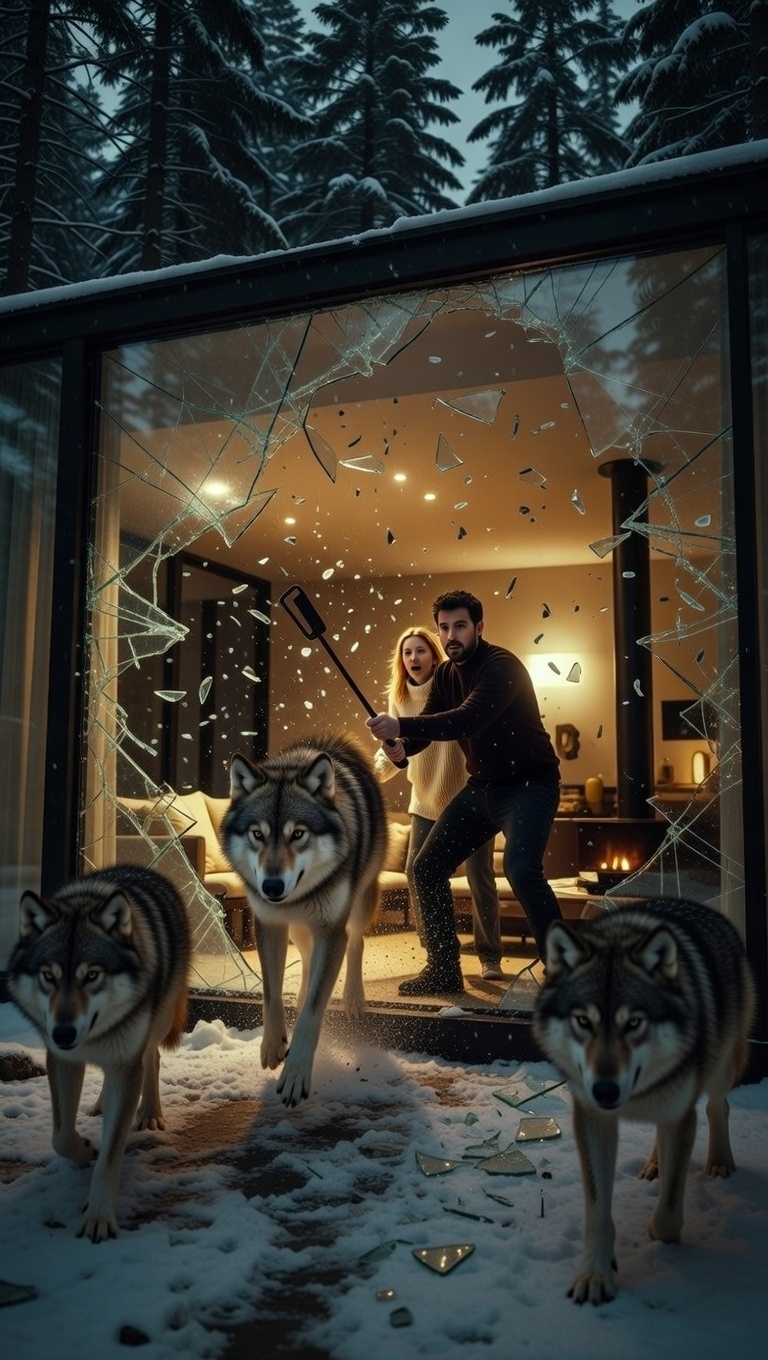
Its shoulder slammed the glass. The crack widened. Shards no bigger than coins tinkled to the floor inside. Cold air rushed in, carrying the smell of wet fur and blood.
Léa screamed—short, involuntary. The sound was tiny, but it was enough.
The pack surged.
Paws hammered every visible pane. Cracks propagated like lightning. One window on the east wall buckled inward; another on the north side starred completely.
Marc loaded the flare gun with shaking hands. “Upstairs—now!”
They ran for the staircase. Halfway up, the first full pane gave way. A black shape exploded through the opening in a spray of tempered glass. The wolf landed on the slate, claws skittering, blood already dripping from pads cut by shards.
Marc fired.
The flare streaked across the room in a blinding magnesium arc and struck the animal square in the chest. White fire bloomed. The beast reared back, howling—a sound like tearing metal—then collapsed, rolling in agony as the chemical blaze consumed fur.
But more were coming.
Another window shattered. A second wolf leapt inside, then a third. They moved with terrifying intelligence—flanking, cutting off the stairs, driving the humans upward.
Léa and Marc reached the master bedroom. Marc slammed the door and dragged the king-size mattress against it. They could hear claws scraping wood, bodies throwing themselves at the barrier.
The bedroom’s glass wall was intact—for now.
Outside, the remaining pack circled below, yellow eyes tracking every movement. The lead wolf—the scarred one—had recovered. It limped but still led, coordinating the assault.
Marc looked at Léa. Her face was pale, eyes wide, but steady.
“The panic room,” she whispered.
The architect had insisted on it—a reinforced concrete cube hidden behind the walk-in closet, with its own oxygen, battery power, food for three days, and a satellite uplink. They had laughed about it at the time. “Who needs a panic room in the Alps?”
They needed it now.
They shoved the closet racks aside. Marc punched the emergency code into the hidden keypad. The steel door hissed open.
They tumbled inside and slammed it shut just as the bedroom window exploded.
Through the small armored viewport they watched the wolves pour into the room—black shadows against the snow-glow, tearing at bedding, overturning furniture, searching.
One pressed its muzzle to the viewport. Hot breath fogged the glass. Yellow eyes stared straight into Marc’s.
Then it turned away.
The pack didn’t waste energy on the panic room. They knew the humans were trapped.
They simply waited.
Inside the concrete box, the emergency light cast a cold white glow. The monitor showed the rest of the house: wolves prowling the living room, curled on the ruined sofa, licking blood from paws. The fire had gone out. The temperature inside the chalet was already dropping.
Marc checked the satellite phone. Signal weak but present. He sent a distress message to the mountain rescue service in Chamonix.
Chalet attacked by wolves. Multiple breaches. Trapped in panic room. Immediate assistance required.
He hit send.
The message spun. Then: Delivered.
Léa leaned against the wall, knees drawn up. “How long until they get here?”
Marc looked at the monitor. The wolves had settled in. Patient. Unhurried.
“Hours,” he said quietly. “Maybe morning.”
The scarred leader lifted its head and looked directly at the camera—as though it knew they were watching.
Léa reached for Marc’s hand.
Outside, the wind rose again, carrying snow through the broken windows.
Inside the panic room, the silence was absolute.
And the wolves waited.

About The Author