Echoes of the Void
Echoes of the Void
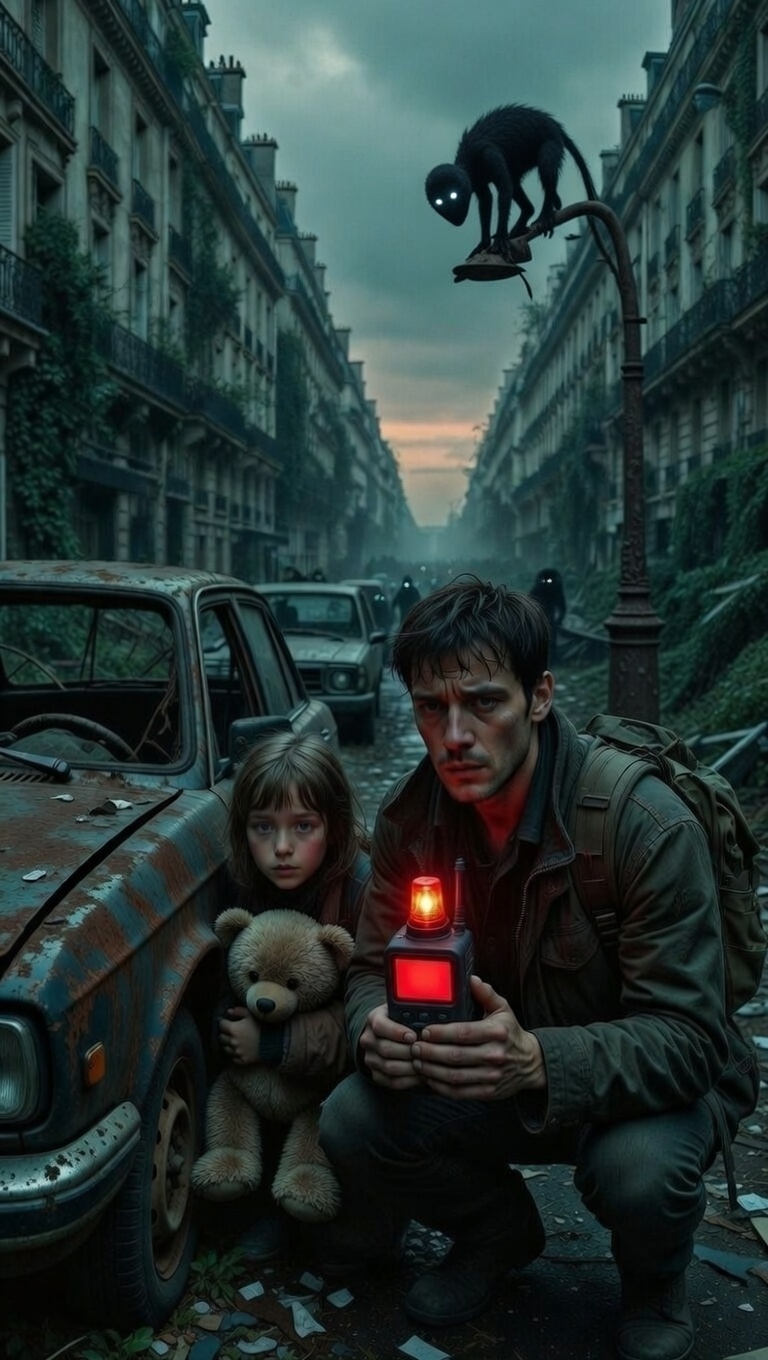
Paris was no longer the City of Light. It had become a vast stone mausoleum where silence was law and sound was death.
The Arrival happened on a Tuesday in November 2024. No warning, no spectacle. One moment the city roared with its usual symphony—horns, sirens, laughter, heels on cobblestones—and the next, everything above 20 decibels simply… stopped existing. Airplanes fell without sonic booms. Gunshots became soft pops. Screams turned to breath. Then the Rôdeurs appeared.
No one knew what they really were. Some survivors called them the Blind Ones. Others said they were the result of a DARPA experiment gone wrong, or a rift torn open beneath the catacombs. Whatever they were, they hunted by sound. A dropped spoon, a cough, a whispered prayer—anything over the safe threshold—and they came. Fast. Silent. Relentless.
Marc Deschamps, 38, former sound engineer for film studios, had spent his career shaping noise. Now he spent every day killing it. His daughter Mia was nine. She barely remembered what a normal thunderstorm sounded like. For her, the world had always been this careful hush, this constant fear of volume.
They lived in a third-floor apartment on Boulevard Saint-Germain, windows blacked out with heavy felt, doors replaced with thick velvet curtains to swallow echoes. They walked barefoot or in wool socks. They spoke mouth-to-ear, lips brushing skin. They ate cold food straight from cans. They survived.
Every dusk, when the wind rose and masked the sound of footsteps, they went out.
On the evening of March 17, 2026, the sky was the color of old lead. A north wind carried the smell of rust and wet concrete. Marc checked his frequency detector—a small, home-built box salvaged from studio gear. The needle hovered at 18 dB. Too close to the red line.
“We take only essentials,” he breathed into Mia’s ear. “Two cans, the spare batteries, bandages. Nothing else. Back before full dark.”
Mia nodded. She wore the oversized backpack lined with felt to muffle shifting contents. She no longer feared the dark. It was the silence before a jaw opened that terrified her.
They descended the stairwell on tiptoe, skipping the creaking third step. Outside, the boulevard was a graveyard of abandoned cars and shattered storefronts. Leaves no longer crackled; they had rotted into mute sludge.
They moved hugging the walls, staying in the shadow of awnings. Their target was the old Monoprix supermarket two blocks away—its basement still held sealed crates behind a false partition Marc had found six months earlier.
They were halfway across the boulevard when the detector buzzed against Marc’s thigh.
The needle spiked to 24 dB.
He froze. Mia felt the sudden tension in his grip and stopped too.
Above them, high in the upper floors of the Haussmann buildings, shapes shifted against the dying light. Not one silhouette. A dozen. Maybe more. Long necks craned downward, heads cocked like listening dogs. Pale, eyeless faces turned in perfect unison.
A pack.
Mia’s breath hitched—a tiny, involuntary sob.
Every head snapped toward them.
Twenty-four blank white eyes fixed on father and daughter.
Marc felt his heart slam so hard he was sure they could hear it through his ribs.
No time for stealth anymore.
He pulled the last flare from his inner pocket—one of the few they had stolen from a Civil Defense truck eight months ago. He ripped the tab.
“Close your eyes and run!”
He fired the flare upward.
A piercing whistle tore the silence—110 decibels of pure, searing magnesium light. The sky turned blood-red for five blinding seconds.
The Rôdeurs shrieked—an ultrasonic wail that vibrated glass and bone. They recoiled, claws scraping stone facades, bodies twisting in agony as the light burned their hypersensitive retinas.
Marc seized Mia’s hand and sprinted.
They zigzagged through the wreckage of cars, boots pounding pavement. Behind them the shrieks turned to enraged snarls. The ground shook with heavy leaps.
“The métro!” Marc gasped.
The entrance to Saint-Germain-des-Prés station was thirty meters away. The iron grille had been half-torn off long ago. They plunged down the stairs, Mia stumbling on the last steps. Marc hauled her up, switched on his headlamp.
The platform was a charnel house—skeletons, torn backpacks, scattered bones. The air stank of mold, old blood, and wet rust.
But there was no other way.
The Rôdeurs were already descending the stairs behind them.
Marc and Mia ran into the tunnel toward Mabillon. The headlamp beam bounced off rusted rails and dripping tiles. They moved in perfect silence, years of practice making their steps synchronized.
Then they heard it.
A deep, subsonic hum rising from the dark ahead.
The queens.
Survivors called them that: the queens. The largest. The oldest. The ones that didn’t hunt—they summoned. They emitted low-frequency pulses that drew packs from kilometers away, a song only Marc’s detector could fully register.
The hum became a slow, hypnotic chant—rising, falling, beautiful in its horror.
Mia stopped dead.
“They know we’re coming, Papa.”
Marc felt ice slide down his spine.
He looked back. The first Rôdeurs were dropping onto the platform, long limbs unfolding, heads swiveling.
Ahead, the tunnel plunged into absolute black.
Only one path left: through.
He took his daughter’s hand.
“Together,” he whispered.
They ran on.
The queens’ song swelled, filled the tunnel, wrapped around their hearts.
Somewhere deep beneath Paris, something enormous opened its eyes.
And waited.
About The Author