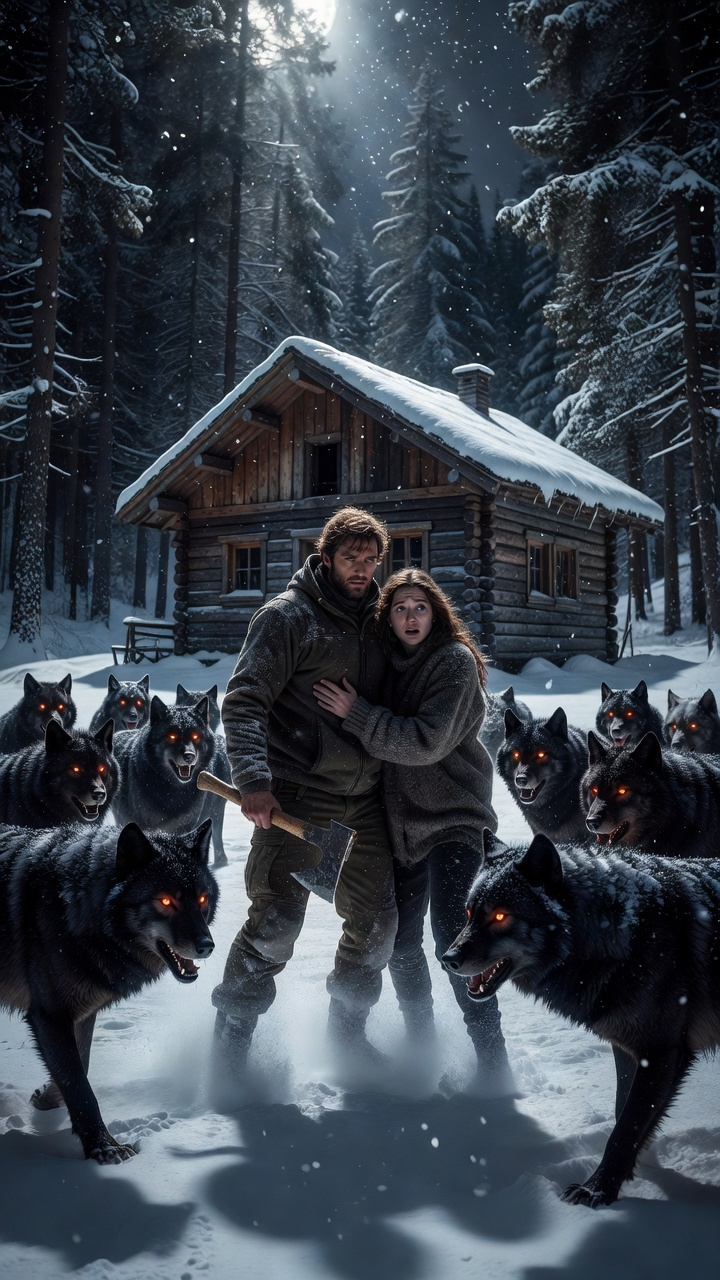
The Alpine Siege
The old cabin had stood on the shoulder of Mont Blanc for three generations, a squat stone-and-timber sentinel at 2,300 meters. Liam’s grandfather used to say it was built to outlast men, not weather. Liam had believed him—right up until the moment the storm arrived.
He and Chloé had driven the last six kilometers in four-wheel drive, chains rattling, visibility down to the hood ornament. The forecast had called for heavy snow; it delivered a white wall that erased the world. They’d come here to hide—from creditors, from the wreckage of Liam’s failed startup, from the quiet implosion of Chloé’s marriage. A week of wood smoke, canned stew, and silence seemed like salvation.
They were wrong.
The first night the wind howled like something alive. By the second it had teeth.
They kept the fire roaring until past midnight. Liam fed it split beech logs while Chloé read an old Jules Verne paperback by lantern light. The cabin smelled of resin and damp wool. Outside, the temperature had dropped to –28 °C. Inside it was almost cozy.
Then the fire began to gutter.
Liam frowned, poked the embers. “Draft’s wrong,” he muttered, and crossed to the window to check the flue. That was when the cabin shuddered.
Not wind. Something heavier. Something deliberate.
Chloé looked up. “Avalanche?”
Liam shook his head. Avalanches don’t pause between impacts.
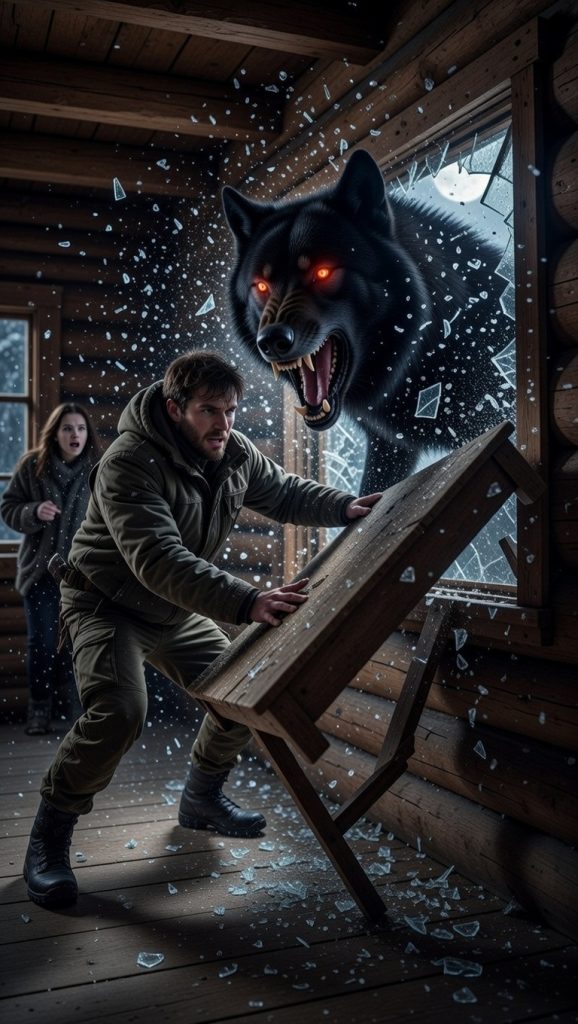
The second shock came harder. A timber groaned. Dust sifted from the rafters. Then—glass. The east window exploded inward in a spray of shards and snow. A head followed: black-furred, massive, eyes the dull yellow of old gold coins. The skull was broader than a wolf’s should be, the muzzle longer, the canines curved like sickles. It was the size of a small bear.
Liam moved before thought. He seized the heavy oak table—four centimeters thick, built by his grandfather—and rammed it against the shattered frame. The beast’s jaws snapped shut inches from his forearm; he felt the heat of its breath, smelled iron and wet fur. Muscles burning, he braced his shoulder against the tabletop while the animal thrashed, claws raking furrows in the wood.
“Chloé—barricade the door!”
She was already moving, dragging the iron stove poker and every chair she could reach. The front door rattled violently—not from wind, but from rhythmic, powerful blows. Wood splintered. Long black claws punched through the planks and peeled them back like orange rind.
“They’re not howling,” Chloé whispered, voice shaking. “They’re… working.”
She was right. No chorus of voices. Only coordinated violence: the thing at the window, the assault on the door, and now—above them—slow, heavy footfalls crossing the slate roof. Tiles cracked. One fell past the broken window and shattered on the floorboards.
Liam’s pulse hammered in his ears. He looked up. A slate tile dropped through a widening hole, followed by a black paw the size of a dinner plate. The ceiling beam creaked.
He grabbed the old fireman’s axe that hung above the mantel. The handle was worn smooth by decades of use. He tested the edge with his thumb—still sharp enough to split bone.
“Chloé, get the shotgun from the loft. Now.”
She scrambled up the ladder, boots thumping on rungs. Liam kept his eyes on the ceiling. Another tile fell. Snow poured in, followed by a second head—identical to the first, yellow eyes locked on him. The beast tore at the rafters with methodical fury.
The shotgun clattered down the ladder. Chloé followed, breathless, clutching the 12-gauge and a half-box of buckshot.
“Only six shells,” she said.
Liam took the weapon, pumped a round into the chamber. “Make them count.”
The roof gave way in sections. Two more creatures dropped through the hole, landing in a crouch amid splintered wood and snow. They were impossibly large—shoulder height almost to Liam’s chest—yet they moved with liquid grace. No wasted motion. No sound except breathing and claws on floorboards.
The first one—the window beast—finally tore the table aside. It stepped into the room, snow sliding off its back like a cloak. Blood crusted the fur around its muzzle; Liam realized with sick certainty that it had already fed tonight.
Chloé backed against the stone chimney. “What are they?”
Liam didn’t answer. He didn’t know. Wolves didn’t grow this big. Wolves didn’t siege buildings like medieval armies. These were something else—older, hungrier, patient.
The four beasts fanned out, cutting off the corners of the room. They didn’t rush. They waited.
Liam raised the shotgun. “Stay behind me.”
Chloé gripped the axe instead. “No. We do this together.”
The lead animal lowered its head, ears flat, lips peeling back. A low rumble rolled out—not a growl, but something deeper, almost a word in a language no human throat could shape.
Liam fired.
The buckshot hit the beast square in the chest. It staggered, blood misting the air, but did not fall. Instead it shook itself once, violently, and advanced again—slower, but unstoppable.
Chloé swung the axe. The blade bit into the shoulder of the nearest creature. It snarled, twisted, and swatted her across the room. She hit the wall hard, slid down, blood on her lip.
Liam screamed her name and fired again. The second blast caught another beast in the face. It yelped—high and almost human—and retreated a step.
But there were more outside. He could hear them: claws on stone, bodies thumping against the outer walls, the slow, deliberate destruction of the roof.
The fire had died to coals. Cold poured in through every breach. Liam’s hands were numb on the shotgun. Three shells left.
Chloé pushed herself up, swaying. She looked at him—not with fear, but with something harder. “The root cellar,” she rasped. “There’s an old escape tunnel Grandfather dug during the war. Under the trapdoor behind the stove.”
Liam remembered. He’d played in it as a child—dark, damp, smelling of earth and mildew. It led down the slope, came out near the tree line.
If they could reach it.
The beasts were closing the circle.
Liam grabbed Chloé’s wrist. “Move.”
They backed toward the stove. One of the creatures lunged. Liam fired point-blank; the recoil slammed his shoulder. The animal dropped, twitching.
Chloé kicked the rug aside, yanked the trapdoor open. A black square of cold earth stared up at them.
The remaining three beasts surged forward.
Liam shoved Chloé down first, then jumped after her, pulling the trapdoor shut just as claws raked the wood above. He slid the heavy iron bar into place—Grandfather’s last line of defense.
Darkness swallowed them.
They crawled.
The tunnel was narrow, barely shoulder-wide, ceiling so low they moved on hands and knees. Frozen dirt scraped their palms. Their breath fogged in front of them. Behind, muffled thuds and splintering wood told them the cabin was being torn apart.
Chloé’s voice, small in the dark: “Do you think they’ll follow?”
Liam didn’t answer. He didn’t know what they were. He only knew they were patient. And patient things wait.
After what felt like hours they saw a faint grey circle ahead—the exit. Liam pushed through first, emerged into thigh-deep snow under a sky that had finally stopped falling.
The storm had passed.
The forest was silent.
No howls. No tracks. Only the wind moving through pines.
Chloé climbed out beside him, shivering, blood frozen on her lip.
They looked back up the slope.
The cabin was a ruin—roof collapsed, walls stove in, windows gone. Smoke still rose from the buried hearth.
Nothing moved.
Liam put his arm around his sister. She leaned into him.
They started down the mountain.
Behind them, in the wreckage of the cabin, something large and black lifted its head from the debris. Yellow eyes watched the two figures shrink into the trees.
It did not pursue.
Not yet.
Some things are willing to wait a very long time.