The Day the Sun Went Out at La Vallière
The estate smelled of sun-warmed jasmine and already-opened champagne forgotten on round tables. Three hundred and twenty guests—family, business partners, carefully vetted childhood friends—formed a pastel sea beneath immaculate parasols. The string quartet played a gentle arrangement of Debussy’s “Clair de lune,” as though the music itself were trying to hold tragedy at bay.
Camille was thirty-two that day. She wasn’t a magazine bride: her shoulders were a little too square from years of carrying moving boxes alone, her hands marked by endless rewrites of screenplays that were first rejected, then accepted, then rewritten until exhaustion set in. But that day, in her ivory silk gown embroidered with tiny seed pearls, she finally felt weightless. She had believed—with an almost religious faith—that Adrien was the man who truly saw her beneath the polite smiles and polite silences.
Adrien was thirty-six, a director at an investment bank that allowed him to wear six-thousand-euro suits without a second thought, and he wore a smile he had perfected in front of television cameras and elevator mirrors. He loved Camille. He really did, in his own way. But he also loved the idea of being loved without conditions, without questions, without ever having to choose between two versions of himself.
They had met at twenty-five in an overpriced cocktail bar in the 6th arrondissement. She was writing her first feature about a woman who vanishes without leaving a forwarding address. He had just broken up with a model who accused him of never being present. They laughed all night. Seven years later, he proposed on a deserted beach in Corsica, kneeling in the cold November sand. She said yes through shivers and tears of joy.
What she didn’t know—what almost no one knew—was that ten months after that proposal, Adrien crossed paths with Léa at an airport. Léa was twenty-nine, a senior analyst at a rival firm, always in impeccable tailoring, fluent in five languages without an accent. She looked nothing like Camille. Perhaps that was why he felt permitted to begin.
At first it was only messages. Then “professional” lunches. Then nights in hotels with neutral names: Novotel, Pullman, Mercure. He would come home at 2 a.m. saying he’d missed the last RER. Camille believed him. She made coffee for two at 7 a.m., kissed his temple, and left to write in her small attic office.
Léa knew. One night in a Geneva hotel room she had asked him straight:
“Are you going to leave her?”
Adrien gave the smile he used in boardrooms when he needed time.
“Soon. When the timing is right.”
“Soon” lasted twenty-two months.
On the wedding day, Léa woke at 5:47 a.m. with a nausea she now recognized. She stared at the white ceiling of her 17th-arrondissement apartment, then made a decision. She put on the black silk dress she kept for funerals and final breakups, slipped the thick kraft envelope into a large leather bag, and drove to La Vallière without GPS, hands tight on the wheel.
At 4:42 p.m., as Camille spoke her vows, voice trembling but radiant—
“Adrien, I chose you even when you no longer saw me. Even when you came home without looking at me. I told myself it was exhaustion, work, life wearing us down… I chose you anyway. And today I choose you forever—”
Léa appeared at the far end of the central aisle.
She didn’t run. She walked. Each step rang like a verdict. Guests turned—first amused, then puzzled, then utterly silent.
She stopped five meters from the altar.
“My name is Léa Morel.”
Her voice was calm, almost official.
“And for twenty-two months I was the woman Adrien met when he said he was working late.”
A collective gasp rippled through the crowd. Several phones lit up in video mode before anyone fully understood.
Léa opened the envelope. The photographs fell in slow, cruel rain: Adrien and her in rumpled sheets, in a tiny Japanese restaurant on rue Sainte-Anne, foreheads touching in an elevator, Camille’s engagement ring clearly visible on his left hand.
Camille stared at the images scattering across the perfectly mown lawn. One landed against her shoe: their two faces pressed together under a streetlamp, dated February 14 of the previous year—the day Adrien had brought her wilted flowers at 11:30 p.m., claiming an urgent file.
Something inside her snapped—not loudly, not dramatically—just a thin, invisible thread giving way.
Adrien had turned ashen. Sweat beaded on his temples, slid along his jaw, dripped onto his shirt collar. He opened his mouth, but no sound came.
Camille lifted her eyes to him. Her pupils were huge, black.
“How many times?” she whispered.
No answer.
Louder: “How many times did you look me in the eyes and say you loved me… while she waited for you somewhere else?”
Still nothing.
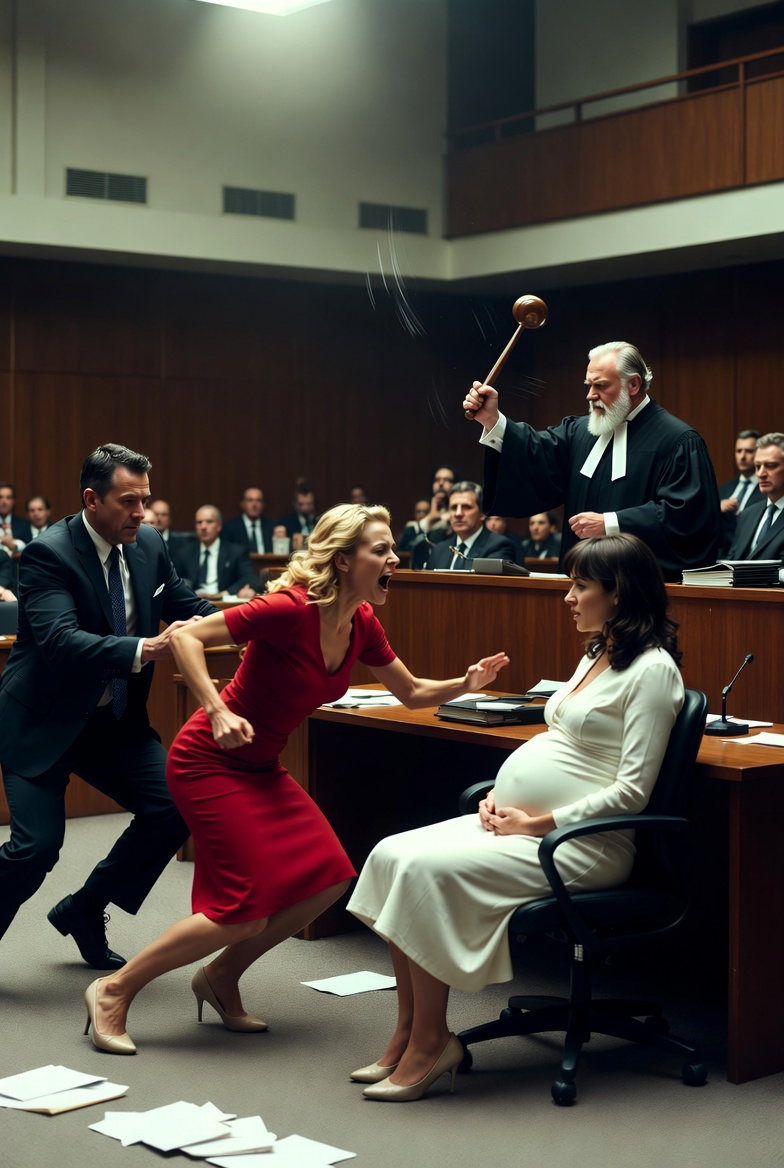
So she raised her hand and slapped him.
The sound cracked like a gunshot. Adrien’s cheek bloomed red within seconds. He swayed but did not step back. He stood there, arms limp, eyes on the photographs.
Camille picked up one image—the February 14 one—and tore it slowly, deliberately, until only white confetti flecked with ink remained.
Then she turned to Léa.
Léa was crying now, silently, tears streaming down her face without being wiped away.
“I asked him to tell you,” she breathed. “Dozens of times. He always promised ‘soon.’ I thought… I thought he would eventually choose.”
Camille looked at her for a long moment. Then, almost gently:
“He never chose. Not you. Not me. He just collected promises.”
She gathered her train in one sharp motion, like ripping off a bandage, and began walking toward the gate.
Guests parted like a funeral procession. Some wept. Others kept filming. Adrien’s mother tried to step forward; his father held her arm.
Camille passed her own mother, who reached out. Camille shook her head softly.
“Not now, Maman.”
She kept walking.
Behind her, Adrien dropped to his knees among the scattered photos. He picked up a torn fragment—their two smiling faces—and crushed it in his fist until the paper tore again.
Léa stood still for a moment. Then she approached him, crouched, and whispered:
“I won’t come back.”
She stood, turned, and walked in the opposite direction from Camille.
The quartet had stopped playing long ago. The silence was so thick you could hear the wind in the cypresses.
On the giant screen meant for projecting their couple photos, someone—perhaps the horrified technician, perhaps an anonymous guest—displayed white letters on black:
“Some truths do not wait for the ceremony to end.”
Camille reached the waiting car, engine already running. The driver got out to open the door; she waved him off. She slid into the back seat, closed the door, pressed her forehead to the cold window.
The car pulled away slowly.
She was no longer crying.
She simply watched the estate recede in the rearview mirror: the white dress moving away from her like a ghost, the frozen guests, Adrien still on his knees.
She whispered to herself, almost inaudible:
“I thought love was enough.”
The car turned at the end of the drive.
And the sun, indifferent, continued setting behind the hills, painting the sky pink and gold—the colors of a day that should never have existed.
Three weeks later, Camille lived in a small hastily rented apartment near Butte-aux-Cailles. She had kept only her books, her laptop, and one suitcase of clothes. She wrote every day, 6 a.m. to 10 p.m., a new screenplay. The story of a woman who disappears on her wedding day and chooses never to return.
She never answered Adrien’s messages.
Léa resigned from her job and left for six months in Iceland. She walked miles on black-sand beaches, took hundreds of photographs of empty landscapes, and never spoke of love again.
Adrien sold their shared apartment. He slept badly. He drank too much. Sometimes he looked at the photos he hadn’t dared throw away and wondered whether he had truly loved either of them, or whether he had only loved the idea of being desired.
La Vallière was rented out for other weddings. The white roses kept blooming. The guests from that day avoided the subject for years.
And Camille, somewhere in Paris, kept writing.
Because sometimes the only way to survive a truth that kills you is to turn it into a story.
End.