THE NUMBER 742
THE NUMBER 742
The call came in at 23:07 on a quiet Tuesday night: “Suspicious and agitated male inside the corner store on Maple and 14th. Possible weapons. Proceed with caution.”
Officer Elena Ramirez killed the lights on her patrol car two blocks away and approached on foot, her German Shepherd, Koda, tight at her heel. The big dog’s ears were already pricked forward, muscles coiled like steel springs. Elena’s hand rested on the grip of her service pistol, thumb brushing the safety. She had done this dance a hundred times, but something about the dispatcher’s tone made the hairs on her neck stand up.
Inside the brightly lit 24-hour minimart, the night clerk stood frozen behind the counter, eyes wide. At the back of the narrow aisle, near the beer cooler, was the man.
He was tall, maybe six-foot-three, but painfully thin, shoulders hunched inside a faded olive-green field jacket that had seen better decades. His hands were visible, empty, yet every line of his body screamed tension. Unshaven, wild graying hair, eyes that had clearly not slept in days. He was muttering to himself, pacing in short, agitated steps.
“Sir, police! Don’t move!” Elena’s voice cut through the humming of the refrigerators. She drew her weapon in one smooth motion, keeping it low but ready. “Show me your hands!”
Koda exploded into barking, deep and savage, the kind that usually made even hardened criminals freeze.
The man stopped pacing. For a terrifying second, Elena thought he was reaching for something. Her finger tightened on the trigger guard.
Then he did something completely unexpected.
Slowly, deliberately, he raised his left arm and rolled up the sleeve of his jacket.
There, on his scarred forearm, was an old tattoo: an American flag, faded and cracked with age, the red stripes blurred into his skin like dried blood. Beneath the flag, in crisp military stencil, were two numbers:
742
Koda’s barking stopped mid-roar.
The sudden silence was louder than the noise had been. The dog’s head cocked sharply to the side. His ears swiveled forward, then back. A low, confused whine escaped his throat — a sound Elena had never heard from him in three years of working together. Not in training, not during arrests, not even when they faced down armed suspects.
The man’s eyes locked onto the dog. Something shifted in his weathered face. Recognition. Pain. Hope.
“742…” he whispered, voice cracking.
Koda took one hesitant step forward, then another. His tail, usually rigid during alerts, began to tremble.
Elena kept her weapon trained, heart hammering. “Sir, identify yourself. Now.”
The man didn’t look at her. He only had eyes for the dog.
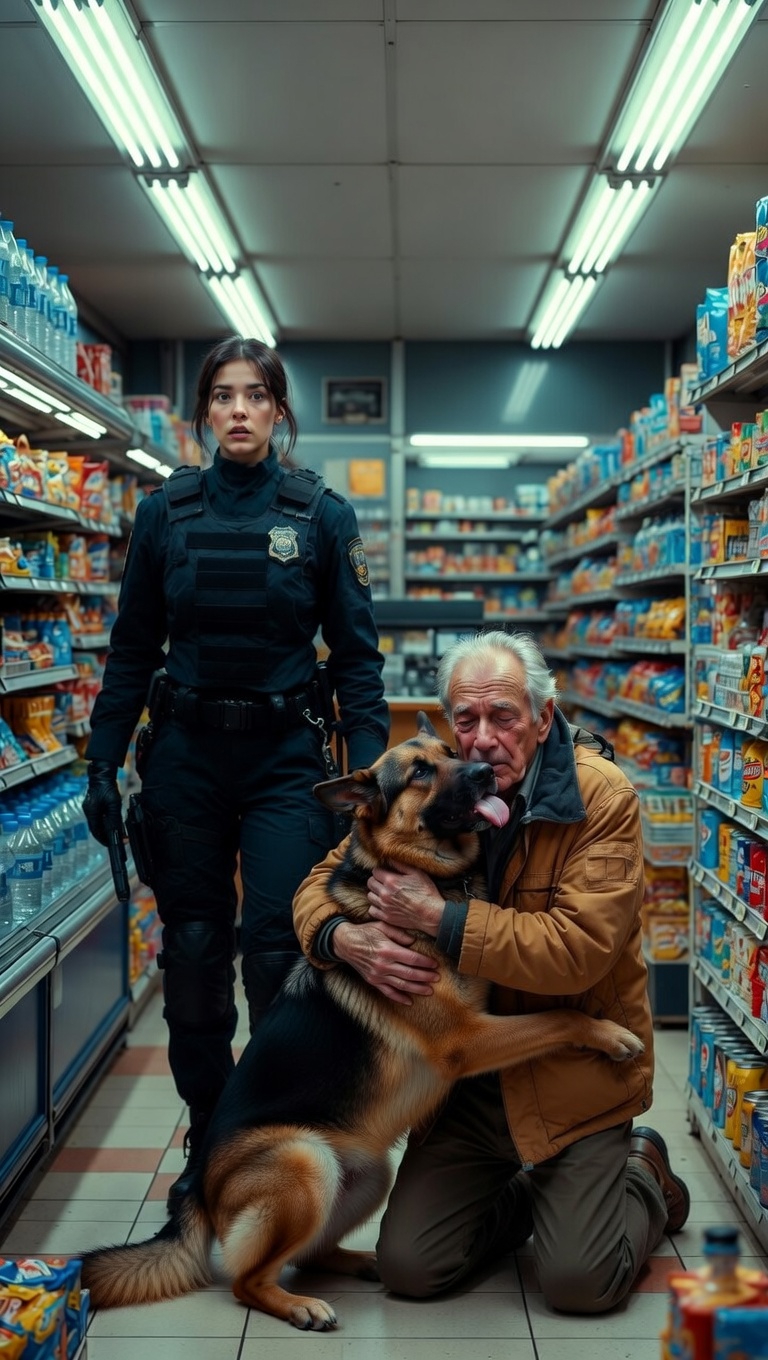
He dropped slowly to his knees on the dirty linoleum floor, right there between the potato chips and the energy drinks. Tears were already cutting clean tracks through the grime on his cheeks.
“Jax…” he breathed. “Is that really you, boy?”
The dog’s entire body began to shake. Then, as if every rule of police K-9 protocol had been erased in a single heartbeat, Koda lunged forward — not to attack, but to reach him.
Elena barely had time to holster her pistol before the 85-pound German Shepherd barreled past her and crashed into the kneeling man, nearly knocking him over. Koda whined loudly, a high-pitched, desperate sound, and began frantically licking the man’s face, his neck, his hands, his ears — anywhere he could reach. His tail whipped so hard it sounded like it might break.
The man wrapped his arms around the dog’s thick neck and buried his face in the black-and-tan fur.
“You remember me, don’t you?” he sobbed. “Your old handler… Ten years, Jax. Ten damn years and you still know me.”
Elena stood frozen, gun now safely holstered, one hand resting on her radio but not keying it. She couldn’t speak.
The night clerk whispered, “Holy shit…”
The man — whose name she would later learn was Sergeant First Class Marcus Hale, retired — had been a elite military working-dog handler with the 75th Ranger Regiment. Ten years earlier, during a night raid in the mountains of Afghanistan, their unit had been ambushed. An IED had torn through their convoy. In the chaos and fire, Marcus had been separated from his dog, Jax — tattoo number 742. The official report listed the dog as killed in action. Marcus had never believed it. He had spent years searching, writing letters, haunting veterans’ groups, slowly drinking himself into isolation and homelessness.
Jax had survived. Badly wounded, he had been rescued by another unit, medically treated, and eventually transferred into the civilian police K-9 program under a new name: Koda. No one had ever connected the dots.
Until tonight.
Marcus rocked gently on his knees, arms locked around the dog that had once saved his life more times than he could count. Jax — or Koda — refused to let go, pressing his big body against the man as if trying to merge them back into one.
Elena finally found her voice, soft now.
“Sir… Marcus, is it? I’m Officer Ramirez. You’re not in trouble. Take all the time you need.”
She radioed in quietly: “Situation downgraded. No suspect. We have… an identification issue. Send animal control and a supervisor, but non-emergency.”
Inside the store, under the cold fluorescent lights, a broken veteran and the dog he thought he had lost forever held each other like they would never let go again.
The night clerk wiped his eyes with the back of his hand and turned the “Open” sign to “Closed” without being asked.
Outside, the city kept moving, sirens wailing in the distance, but inside that little corner store, time had stopped for two old soldiers who had finally found their way back to each other.
Some bonds, it seemed, were stronger than war, stronger than time, and stronger than death itself.
The number 742 had come home.

About The Author