The Shadow Champion
The Shadow Champion
No one at Westfield High ever really looked at Mark Harlan.
He was the kid in the oversized grey hoodie who always sat in the back row, hood up, earbuds in, eyes on the floor. He ate lunch alone behind the gym bleachers. He walked the halls like a ghost, never bumping shoulders, never meeting anyone’s gaze. Teachers called him “quiet” on report cards. Students called him “weird” behind his back. To the school, he was background noise—barely worth noticing.
That changed on March 14, the last Friday before spring break.
The gym was packed for the annual “Spring Slam” charity basketball exhibition. Bleachers full. Phones recording. The cheer squad mid-routine. The air smelled of popcorn, sweat, and teenage bravado.
Caleb “Cal” Ramsey—senior, captain of the varsity team, 6’4″ with a smile that sold toothpaste—was running the show. He had been Westfield’s golden boy since freshman year: full ride to Duke already signed, prom king in the bag, every girl’s Snapchat story. He thrived on attention the way plants thrive on light.
Mark was sitting alone on the lowest bleacher row, hoodie zipped to the chin, watching the game with the detached interest of someone who had seen better.
Cal noticed him.
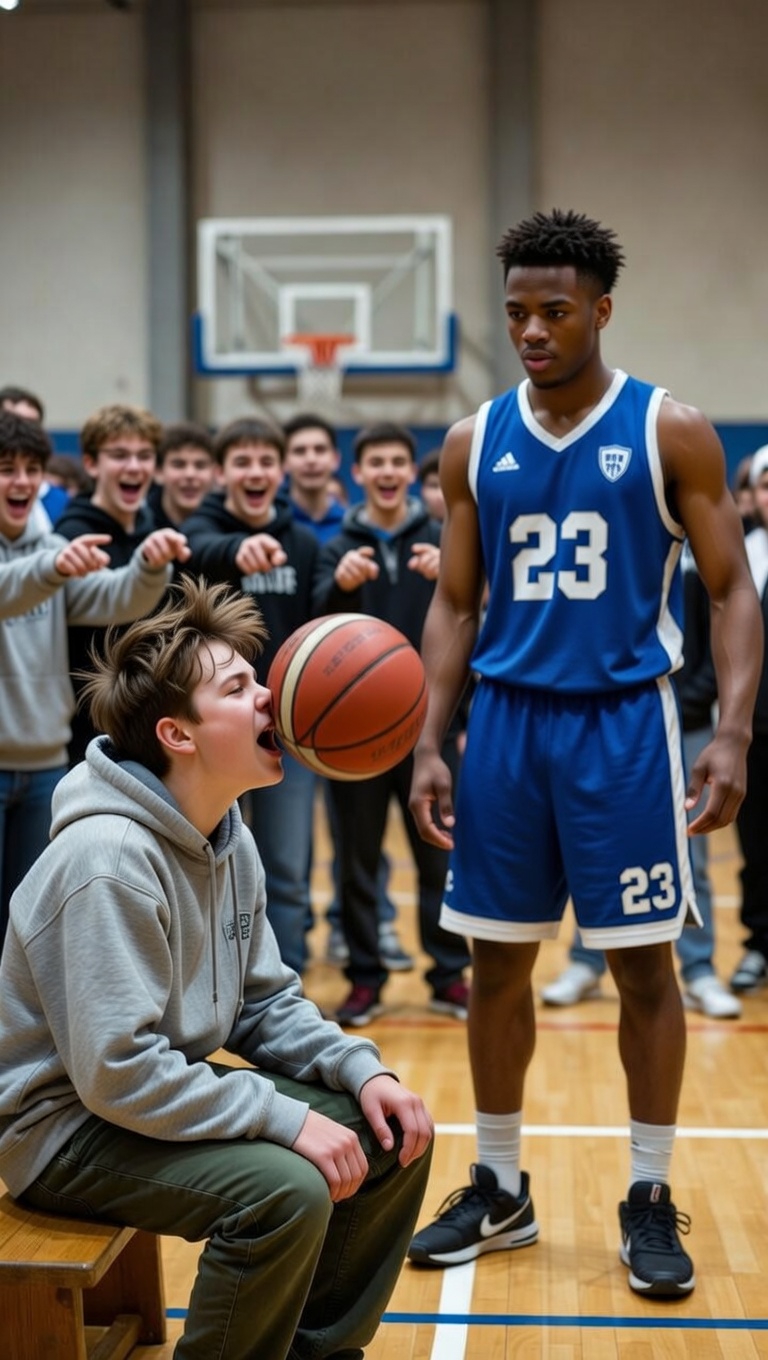
During a timeout, Cal grabbed the ball, spun it on his finger like a toy, and lobbed it—hard—straight at Mark’s face.
The impact was loud: a wet smack of leather on cheekbone. The ball ricocheted off Mark’s head and bounced into the crowd. A collective gasp rolled through the gym, followed by laughter—sharp, cruel, contagious.
Mark didn’t flinch. Didn’t yelp. He stayed seated, head lowered, a red welt already blooming across the bridge of his nose. Blood trickled from one nostril, slow and dark.
Cal jogged over, grinning, arms wide like he was conducting an orchestra.
“Yo, hoodie! You good?” he called, loud enough for the microphones to pick up. “Or do I need to throw it slower next time?”
More laughter.
Cal stepped closer, towering over Mark.
“Look at me when I’m talking to you, freak.”
Mark remained still for a long moment.
Then—slowly—he lifted his head.
The laughter died in patches.
Because the eyes looking up at Cal were not the eyes of a victim.
They were calm. Cold. Almost amused.
Mark reached up with one hand and wiped the blood from his upper lip. He stood.
He was taller than anyone expected.
The hoodie had hidden it well—broad shoulders, long arms, the kind of lean, coiled muscle that belongs to someone who has spent years training in silence. When he shrugged the hood back, his hair was cropped short, military-neat. A thin scar ran along his left eyebrow—old, faded, professional.
Cal’s smirk faltered.
Mark spoke for the first time anyone could remember hearing him speak.
“Pass me the ball.”
Cal blinked. Then laughed—too loud, too forced.
“You serious?”
Mark didn’t repeat himself.
Cal bounced the ball once, twice—then tossed it hard at Mark’s chest, the way bullies toss things when they still think they’re in control.
Mark caught it one-handed. The leather smacked his palm with a sound like a gunshot.
Then he moved.
He took two steps forward—fast, fluid, predatory—and exploded.
A hesitation dribble. A crossover so quick Cal’s ankles almost buckled. A step-back three-pointer from the top of the key.
The ball left his hand clean.
It swished through the net without touching the rim.
Silence.
Absolute silence.
The entire gym watched as Mark walked to the baseline, picked up the ball again, and looked at Cal.
“Again.”
Cal’s face flushed red. He stepped forward, chest out.
“You think you’re hot shit now?”
Mark dribbled once—low, controlled.
“I think you just woke someone up.”
He exploded again.
This time it was a drive—left shoulder dip, hesitation, spin move past Cal’s clumsy lunge. Cal reached out to grab Mark’s arm; Mark twisted under the reach, flipped the ball behind his back, caught it with the other hand, and laid it up with his left—off the glass, no rim.
Swish.
The crowd made a sound that wasn’t quite a cheer—more like a collective inhale.
Cal charged.
Mark didn’t dodge. He met him.
A quick jab step, then a hesitation dribble. Cal overcommitted; Mark pulled the ball back, crossed over, and drove right—straight past him. Cal stumbled, arms windmilling. Mark rose at the rim, cocked the ball back, and threw down a one-handed tomahawk dunk so violent the rim vibrated for three full seconds.
The backboard rattled.
The gym exploded.
Phones were up. Cheerleaders froze mid-routine. Teachers stood open-mouthed.
Mark landed lightly, jogged back to the free-throw line, and looked straight at Cal.
Cal was breathing hard, face scarlet, pride bleeding out of him.
Mark bounced the ball once—slow, deliberate.
“You done?” he asked.
Cal didn’t answer.
Mark turned to the crowd.
“I’m not here to be your punching bag,” he said, voice low but carrying. “I’m here because I used to play. I was good. Really good. Then my mom got sick. Then she died. Then I stopped playing. I came here to disappear. But you wouldn’t let me.”
He looked at Cal again.
“So if you want to keep playing king of the gym, go ahead. But next time you throw a ball at my face, I won’t just dunk on you.”
He dropped the ball. It bounced twice, then rolled to a stop.
He walked toward the exit.
The crowd parted without being asked.
No one laughed. No one jeered.
They just watched him go.
Behind him, Cal stood frozen in the center of the court, staring at the ball like it had betrayed him.
On Monday, the video was everywhere.
By Tuesday, college scouts were calling the athletic director.
By Wednesday, Mark Harlan was no longer “the kid in the hoodie.”
He was the shadow champion.
And the gym would never feel quite the same again.
About The Author