The Survivors of the Summit
The Survivors of the Summit
Claire’s thirtieth birthday had been planned for months. Not a party in Paris, not a weekend in the Côte d’Azur—something she had wanted since she was a child: a private flight over the Mont Blanc massif at sunset, champagne at altitude, the whole Alps laid out beneath them like a frozen kingdom. Thomas had made it happen. He chartered a sleek Pilatus PC-12, booked the best pilot in Chamonix, and kept the destination secret until they were already airborne.
They took off from Megève Altiport at 16:20 on December 12, 2026. The sky was flawless—deep cobalt above, gold bleeding into rose along the western horizon. Claire wore the cream cashmere scarf Thomas had given her that morning; he wore the quiet pride of a man who had finally learned how to make his wife smile without words.
At 4,100 meters, crossing the Vallée Blanche, the pilot’s voice came over the intercom—calm, professional.
“Light icing on the wings. Nothing serious. We’ll climb a little higher, clear air above.”
Thomas squeezed Claire’s hand. She leaned her forehead against the cool window, watching the Aiguille du Midi slide past like a blade of granite.
Then the engine coughed.
Not a sputter—a single, sharp hiccup. The propeller slowed for half a second, then caught again.
The pilot frowned at the instruments.
“Carburetor icing. Switching to alternate air.”
He pulled the lever.
The engine died.
No warning growl, no gradual fade—just silence. The propeller windmilled uselessly. The alarms shrieked: stall warning, terrain proximity, master caution. The artificial horizon tilted.
“Mayday, mayday, Golf-Alpha-Charlie November, total engine failure, 4,100 meters over Mont Blanc. Attempting restart.”
The pilot yanked the starter. Nothing. He tried again. Silence.
The plane began to sink.
Claire’s hand tightened on Thomas’s until her knuckles whitened.
“Brace,” the pilot said—still calm, but tighter now. “We’re going in.”
The nose dropped. The stall horn wailed. Snow rushed up to meet them.
The impact was not clean.
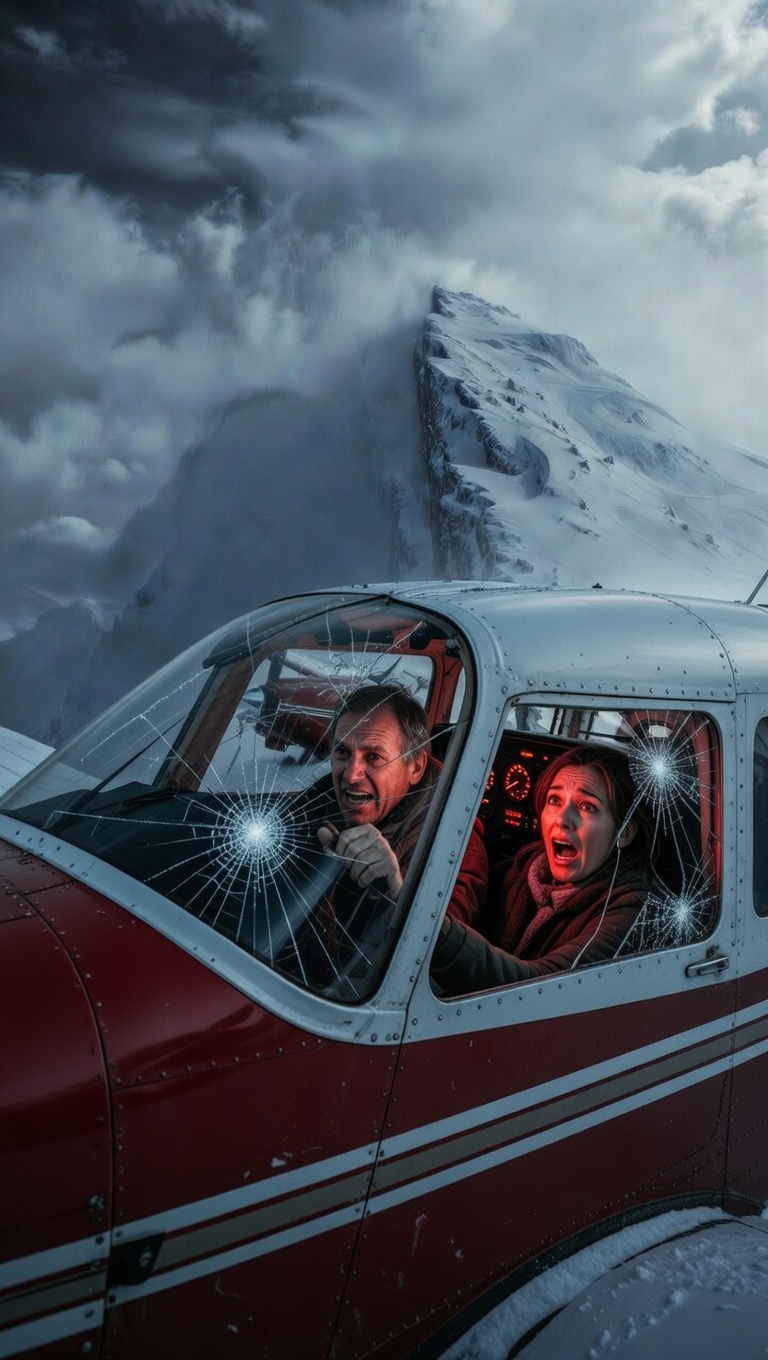
The right wing caught first—snapped against a ridge of ice, spun the fuselage like a top. Metal tore. Glass exploded inward. The cabin filled with snow and screaming wind. Thomas threw himself over Claire as the plane cartwheeled, shedding parts, grinding across the glacier for forty meters before slamming to a stop against a serac.
Silence—real silence—returned.
Then pain.
Thomas tasted blood. His left shoulder was dislocated; something hot and wet ran down his temple. Claire was slumped against him, breathing shallowly, a deep gash across her right forearm. The pilot was motionless, head lolling at an impossible angle, neck broken.
They were alive.
Barely.
Thomas unbuckled them both. Cold poured through the shattered fuselage like water. He dragged Claire out into the snow. The wind was already rising—sharp, knife-edged. Visibility dropped to twenty meters. The sun was gone; the sky had turned the color of old lead.
He looked around.
They had crashed on a narrow arête—a razor-backed ridge at 3,800 meters—flanked by sheer drops on both sides. Below them, the Glacier du Géant fell away in a chaos of crevasses and icefalls. Above, the summit ridge of Mont Blanc disappeared into swirling cloud.
The wreck was burning.
Kerosene spilled from a ruptured wing tank, pooling orange and black on the snow. Flames licked up the fuselage. Thomas pulled Claire farther away, upwind, until they reached a small ice ledge sheltered by an overhanging boulder.
He checked her pulse—fast but steady. She opened her eyes.
“Thomas…”
“I’m here.”
“The pilot?”
He shook his head.
Claire’s teeth chattered. “We’re going to die.”
“Not today,” he said, though he wasn’t sure he believed it.
He inventoried what they had.
From the wreckage: one emergency blanket, a half-frozen water bottle, a small first-aid kit (bandages, painkillers, antiseptic wipes), the pilot’s satellite phone (screen cracked but still powered), and Thomas’s own backpack—containing a lightweight down jacket, two energy bars, a headlamp, and—thank God—a 30-meter length of 6 mm accessory cord and a single locking carabiner he had brought “just in case” they wanted to scramble on some easy rocks.
No sleeping bag. No stove. No real shelter.
The wind rose to a howl. The temperature was already –18 °C and falling fast. The forecast had called for a storm front moving in after midnight.
And then the whiteout began.
It started as drifting snow—soft, almost beautiful. Within minutes it thickened into a blinding wall. Sky and ground merged. Depth vanished. The ridge disappeared beyond five meters. They could no longer see the wreck’s flames; only the orange glow diffused through the blizzard.
Thomas wrapped the emergency blanket around Claire, then zipped his jacket over both of them as best he could. He pressed his back against the boulder, holding her against his chest.
“Stay awake,” he whispered. “Talk to me.”
She tried. Her voice was thin. “Remember the night we met? You spilled red wine on my dress.”
He forced a smile. “You told me it was an improvement.”
She laughed—weak, but real.
They talked for hours—about their first apartment, about the dog they never got, about the baby they kept postponing. Anything to stay conscious.
At some point Claire’s words slurred. Her shivering slowed—a dangerous sign.
Hypothermia.
Thomas knew the descent was their only chance. The ridge dropped 200 meters to the Col du Géant, where a high-altitude refuge might still stand. If they could reach it before full dark, before the cold shut down their bodies, they might survive until rescue.
He tied the accessory cord around both their waists—double fisherman’s knots, tight. He clipped the carabiner to Claire’s harness loop, then to his own belt. If one fell, the other would be anchored.
He stood.
Claire tried to rise and staggered.
“I can’t feel my feet,” she said.
“You don’t have to. Just lean on me.”
He half-carried her to the edge of the arête. The drop was vertical—ice-polished granite and snow, disappearing into white nothing.
He drove the ice axe (salvaged from the pilot’s survival kit) into the snow, tested it, then began lowering Claire first—feeding the rope around his hips in a classic body rappel, boots braced against the ice.
The wind tried to peel them off the face.
Halfway down, Claire slipped. The rope burned through Thomas’s gloves. He locked off, caught her weight. She dangled, gasping.
“I’ve got you,” he said through clenched teeth.
He lowered her the rest of the way to a narrow ledge, then rappelled down himself.
They continued—slide, lower, rest, slide, lower. Every meter cost heat, strength, time.
At 3,600 meters, Claire stopped moving.
Thomas knelt beside her. Her lips were blue. Her eyes fluttered.
“Stay with me,” he begged.
He pressed his forehead to hers.
“I love you,” she whispered.
“Don’t say goodbye. Not yet.”
He lifted her again—fireman’s carry now—and kept going.
At 3,400 meters, the slope eased. He stumbled forward through drifts up to his thighs.
Then—a shape in the white.
The refuge hut.
Small, metal, half-buried.
He kicked the door open.
Inside: two bunks, a table, an emergency stove, blankets, a first-aid kit, and—miracle of miracles—a working VHF radio.
He laid Claire on the lower bunk, wrapped her in every blanket, started the stove. He radioed mayday.
“Mont Blanc rescue, this is survivor of private aircraft crash near Col du Géant. One female, severe hypothermia. We need immediate evac.”
The voice that answered was calm, professional.
“Copy. Helicopter en route. ETA thirty minutes. Stay warm. Keep talking to her.”
Thomas crawled onto the bunk beside Claire. He held her close, rubbing her arms, whispering every memory he could think of—their first kiss in the rain, the night she laughed so hard she snorted wine, the morning she said yes to marrying him.
She stirred once.
“Thomas?”
“I’m here.”
“Did we make it?”
He kissed her forehead. “We made it.”
Outside, the storm howled.
But inside the tiny hut, two people clung to each other and waited for the sound of rotors.
And somewhere above, the mountain—ancient, indifferent—settled back into silence.
They had survived the giant’s awakening.
For now.

About The Author