The Turn
The Turn
The courtyard of Lycée Victor Hugo was the usual battlefield at 3:15 p.m.: seniors lounging on the low stone wall, juniors clustered near the bike racks, everyone pretending not to watch the ritual humiliation unfolding near the fountain.
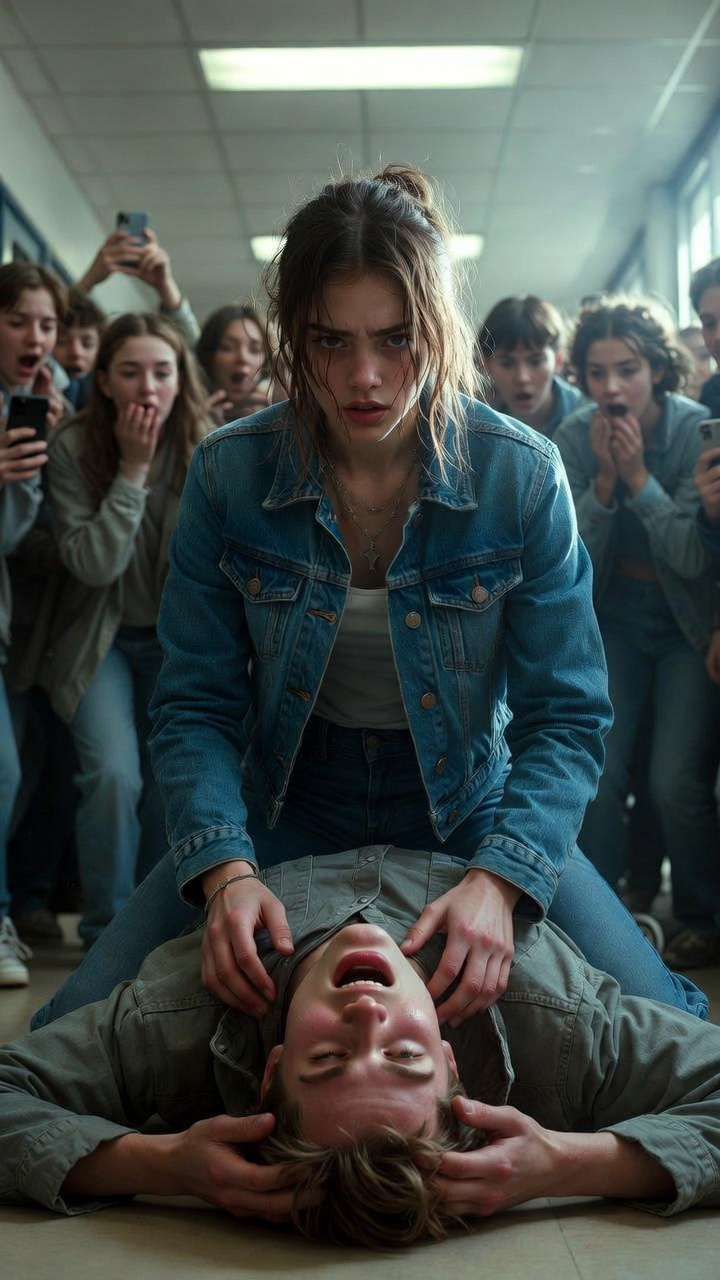
Camille Moreau, fifteen, stood with her back to the cold marble basin. Her denim jacket—second-hand, sleeves rolled twice—was zipped to the chin. Her dark hair was pulled into a messy knot, strands escaping like they were trying to run away. She kept her eyes on the ground. That was rule number one when Victor “Vic” Laurent decided you were today’s entertainment.
Vic was built like a rugby prop—sixteen, broad shoulders, perpetual smirk. He had three lieutenants orbiting him: Théo, who filmed everything, Léo, who laughed the loudest, and Max, who mostly just blocked escape routes. The phone screens were already up. The crowd formed a loose semicircle. Someone muttered “go on, Vic,” and a ripple of nervous giggles followed.
Vic stepped closer, snatched the sketchbook from under Camille’s arm. He flipped it open, held up a page—a detailed pencil drawing of a crow mid-flight—and tore it slowly in half.
“Still doodling birds, Moreau?” he said, loud enough for the back row. “Maybe you should draw something useful. Like how to disappear.”
He dropped the pieces into the fountain. The paper floated, ink bleeding into the water.
Camille didn’t move. Didn’t speak. Didn’t cry. She had learned early that tears only fed the machine.
Vic leaned in, voice dropping to a mock whisper. “What? No comeback today? You finally figure out your place?”
That was when something inside Camille shifted—not broke, shifted.
She lifted her head.
The shift was small, almost invisible. A slight straightening of the spine. A softening of the shoulders. A change in the way she breathed—in through the nose, out through the mouth, steady, controlled.
Vic saw it too late.
Camille stepped forward—inside his reach, where he expected fear to keep her frozen—and pivoted on her left foot. Her right leg snapped up in a perfect roundhouse kick. The arc was textbook, hip turning first, knee driving through, shin whipping like a blade. The ball of her foot caught Vic clean under the jaw.
The sound was wet and sharp—leather sneaker on bone.
Vic’s head snapped sideways. His knees folded. Two hundred pounds of arrogance dropped like a cut puppet.
The courtyard went dead quiet.
Camille didn’t stop.
She stepped over his fallen arm, pivoted again, and drove a tight elbow into the solar plexus of Théo, who had instinctively lunged forward with his phone still recording. He doubled over, air exploding out of him in a wheeze. She followed with a rising knee that caught him under the chin. His head rocked back; the phone clattered across the flagstones.
Léo tried to grab her from behind. Camille dropped her weight, hooked his wrist, twisted, and threw him over her hip in a clean ippon. He landed hard on his back, breath knocked out, staring at the sky.
Max hesitated—one second too long.
Camille closed the distance in two steps, feinted high with her left hand, then drove a low front kick into his thigh. The peroneal nerve lit up; his leg buckled. She finished with an open-palm strike to the nose—not to break it, just to make his eyes water and his brain reconsider.
Four seconds. Maybe five.
The crowd—phones still raised—had gone from laughing to frozen. Mouths open. Eyes wide. No one cheered. No one ran. They simply stared, as if the laws of physics had rewritten themselves in real time.
Camille stood in the center of the semicircle, breathing through her mouth, hands loose at her sides. No shaking. No tears. Just a cold, steady calm that made the air feel thinner.
Vic groaned, rolled onto his side, tried to push himself up. Camille stepped forward one pace. He froze.
She looked down at him—not with hate, not with triumph. With something quieter. Finality.
“Next time,” she said, voice low but clear enough to carry, “pick someone else.”
She turned, walked through the parted crowd. Phones tracked her the whole way, but no one spoke. No one followed.
Behind her, Vic stayed on the ground. Théo wheezed. Léo stared at the clouds. Max rocked slowly, clutching his thigh.
The bell rang—long, indifferent.
Classes resumed.
But something in the courtyard had changed forever.
Camille didn’t go to class. She walked straight to the art room, sat at her usual table, pulled out a fresh sketchbook, and began to draw.
This time, the bird wasn’t flying away.
It was landing.
Talons first.
About The Author