The Wall of Silence
The Wall of Silence
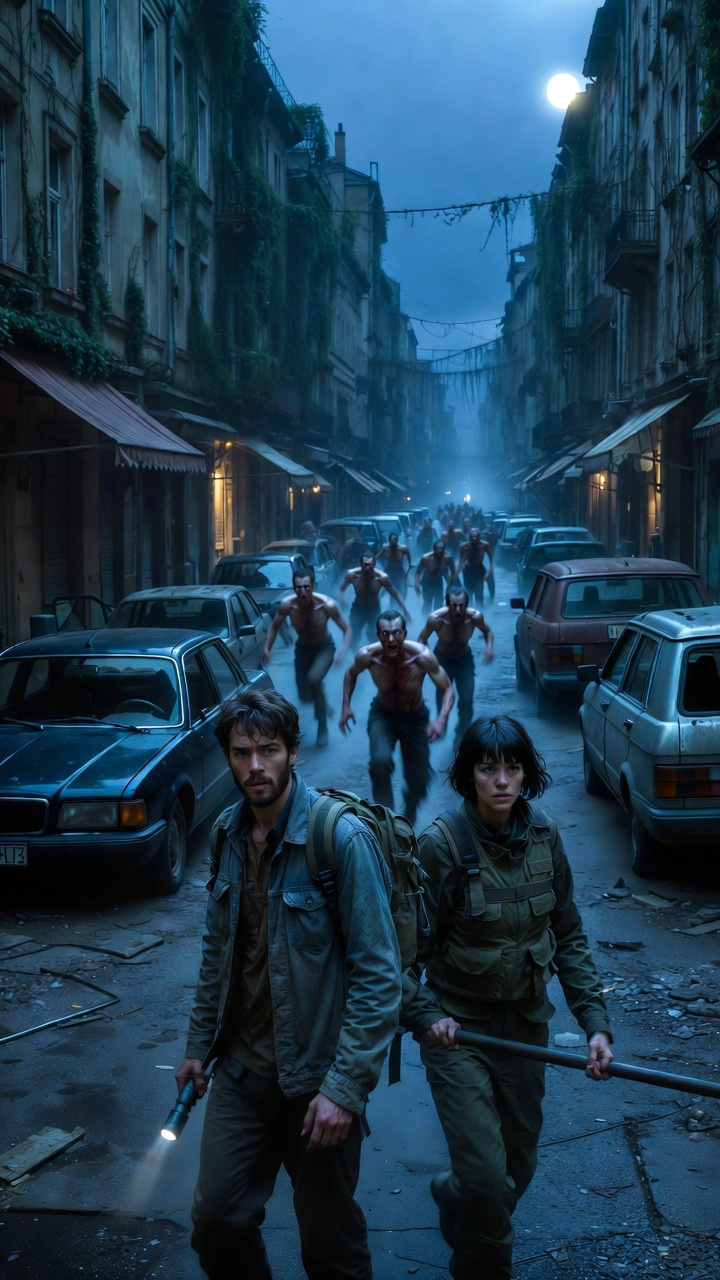
The city had once been called Berlin. Now it had no name. No one bothered with labels anymore. The streets were choked with vines and rusting cars, the skyline a jagged line of broken teeth against a perpetual grey sky. The Infection had arrived seven years earlier—not with fanfare, but with a whisper. A virus that rewired the brain’s auditory cortex, turning sound into a beacon. Anything above 15 decibels drew the Infected like moths to flame. They didn’t see. They listened. And they were always hungry.
Marc and Lucie had learned to live inside that silence. They spoke in gestures, wrote notes on scraps of paper, breathed through their mouths to muffle the sound of air moving through nostrils. Their shoes were wrapped in layers of cloth and duct tape; every step was deliberate, soft, rehearsed. They had survived longer than most because they understood the new rules: noise was death.
They moved only at twilight, when the wind through ruined buildings created enough ambient cover to mask their footsteps. Tonight they needed antibiotics. Lucie had developed a fever two days earlier—nothing dramatic yet, just a low burn behind her eyes and a tremor in her hands. Marc refused to let it become something worse. There was a pharmacy in the old Europa-Center mall, three kilometers east. They had scouted it twice before. The route was viable. The risk was acceptable.
Or so they told themselves.
They left their hideout—an abandoned U-Bahn maintenance tunnel beneath Alexanderplatz—at 18:47. The sky was the color of old bruises. A thin drizzle fell, turning the asphalt into a slick black mirror. Marc led, carrying the crowbar and the backpack. Lucie followed, pistol tucked into her waistband, flashlight hooded with red gel to preserve night vision.
They communicated only in hand signals:
Left turn. Stop. Listen.
The city was never truly silent. Wind sighed through broken windows. Water dripped from gutters. Rats scratched inside walls. All of it was safe—below the threshold. Anything louder was suicide.
They crossed Karl-Liebknecht-Strasse without incident, hugging the shadows of collapsed billboards. The mall loomed ahead, a gutted glass cathedral. Most of the facade had fallen years ago, leaving a skeleton of steel and shattered panes. They slipped through a service door Marc had pried open months earlier.
Inside, the air was thick with mildew and the faint copper smell of old blood. Escalators hung like broken spines. Shop fronts gaped, looted long ago. Marc pointed toward the pharmacy at the far end—still sealed behind a roll-down shutter he had never managed to breach before.
They moved carefully, stepping over broken glass and fallen ceiling tiles. Halfway across the atrium, Marc’s foot nudged something small and metallic.
A single empty soda can.
It rolled two centimeters.
The metallic clink echoed off the high ceiling like a gunshot.
Three seconds of absolute stillness.
Then the city answered.
From every shadowed doorway, every collapsed storefront, every rent in the ceiling, shapes emerged.
They were not the shambling corpses of old horror films. The Infected moved like marionettes with cut strings—jerky, impossibly fast, muscles twitching with unnatural energy. Their eyes were milky white, pupils vanished. Their heads cocked at impossible angles, ears straining toward the source of the sound.
Marc felt the air change. A low, collective hiss rose—dozens of throats vibrating at once.
Lucie grabbed his sleeve. Her eyes said: Run.
They ran.
The atrium became a killing floor. Infected poured from upper levels, leaping from balconies, scrambling down escalators on all fours. Their movements were simian, fluid, terrifying. One vaulted over a fallen chandelier, claws scraping marble. Another climbed straight up a pillar, using rebar stubs like handholds.
Marc and Lucie sprinted toward the pharmacy corridor. Behind them the hiss became a chorus of high, keening cries—ultrasonic, bone-deep, designed to paralyze prey with fear.
They skidded around a corner. The pharmacy shutter was still down. Marc dropped to one knee, jammed the crowbar into the track, and heaved. Metal screamed. The shutter lifted six inches—then stuck.
Lucie spun, pistol raised. The first Infected rounded the corner—former security guard, uniform shredded, face half gone, teeth bared in a permanent snarl. She fired twice. Both shots hit center mass. The creature staggered but kept coming.
Marc yanked harder. The shutter rose another foot.
Lucie fired again. The Infected dropped, but three more took its place.
Marc shoved his shoulder under the bar and pushed upward with his legs. The metal groaned, bent, gave way. The shutter shot up with a clang.
They dove through the gap.
Inside was darkness and dust. Shelves had collapsed; pill bottles crunched underfoot. Marc pulled the shutter down behind them and wedged the crowbar through the handle slots.
For a moment, silence.
Then scratching. Clawing. The shutter rattled as bodies threw themselves against it.
Lucie backed away, breathing through her mouth to stay quiet. Marc swept the room with the red flashlight. They found the antibiotics—amoxicillin, cefuroxime, a half-dozen blister packs still sealed. He stuffed them into the backpack.
The shutter buckled inward. A clawed hand punched through the gap between slats.
Marc looked at Lucie. No words. Just a nod.
They moved deeper into the pharmacy, toward the stockroom at the back. There was a service corridor there—narrow, unlit, leading to the loading dock. If they could reach it, they might lose the pack in the maze of service tunnels beneath the mall.
They slipped through the stockroom door just as the shutter gave way completely.
The Infected flooded in—dozens now, drawn by the earlier shots and the clanging metal. They didn’t search methodically. They hunted by echo, triangulating every sound.
Marc and Lucie ran.
The corridor was pitch black. Their red lights barely cut the gloom. Pipes dripped. Somewhere ahead, water rushed—perhaps a broken main. They followed the sound, letting it mask their footsteps.
Behind them, the cries grew fainter. The Infected were spreading out, confused by the multiple echoes.
They reached a T-junction. Left: loading dock. Right: deeper tunnels.
Marc hesitated. The dock would lead to open ground—exposed. The tunnels might dead-end.
He chose right.
They descended a metal staircase, boots muffled by layers of cloth. The air grew colder, damper. The sound of water grew louder.
At the bottom, a chamber opened—old mechanical room, pumps long silent, pipes thick with rust. A single emergency light still glowed faintly, powered by some forgotten battery.
They stopped to breathe.
Lucie leaned against a pipe, eyes closed. Marc checked her forehead—still warm, but not burning. The antibiotics would help if they could get them home.
He looked at her. She opened her eyes.
They didn’t speak. They didn’t need to.
A soft scrape echoed from the staircase.
Marc raised a finger to his lips.
They moved again, slower now, deeper into the dark.
The city above had become a wall of silence.
But below, in the forgotten veins of Berlin, something was still listening.
And it was coming closer.


About The Author