Water That Doesn’t Freeze
The lobby of the Grand Impérial Hotel in Paris was a temple of light and marble. At eleven o’clock at night, the Bohemian crystal chandeliers cast golden rain across the mirror-polished floor. Rose-veined limestone columns seemed to breathe beneath the glow of gilded wall sconces. The faint clink of champagne flutes and the muffled laughter of women in furs were barely audible. Everything smelled of power, Italian leather, and perfume that cost three thousand euros a bottle.
Émilie sat on the floor, back against the base of a column, like a stain on a masterpiece. Her gray coat—far too thin for February—was soaked with rain. Her black hair, cut short after a lice infestation the previous year, clung to her temples. She was shivering. Not only from the cold. From exhaustion. From hunger. From the absolute certainty that she should never have come here.
Three hours earlier she had walked from Gare de Lyon, torn backpack on her shoulder, carrying the last pieces of evidence inside: a yellowed letter from 2012, a crumpled property deed, a photograph in which her father still smiled in front of this very hotel that had once been half his. Before Laurent Beaumont stole it.
She had asked to speak to the manager. They had laughed in her face. “Mademoiselle, this establishment does not receive… walk-in visitors without a reservation.” So she had sat down. Right there. Because her legs would carry her no farther. Because if she left now, she knew she would never come back.
That was when Laurent Beaumont and his wife walked in.
He wore a bespoke black Tom Ford suit, immaculate white shirt, anthracite silk tie. On his arm, Claire Beaumont in a camel Loro Piana cashmere coat and stiletto boots that struck the floor like whip cracks. They were returning from a private dinner on the top floor with Qatari investors. Laurent was still chuckling at a joke he had just made about “people who think you can enter our world with a bus pass.”
His gaze fell on Émilie.
He stopped dead. A slow, almost tender smile spread across his lips.
“Well, well… look at this, darling. A little homeless girl squatting in our lobby.”
Claire turned her head, eyebrows perfectly arched. “My God, Laurent… she’s drenched. She looks like a drowned cat.”
Around them, a dozen wealthy guests had already paused. Men in tuxedos, women in long gowns, all wearing the amused expression one reserves for slightly vulgar street performances. No one moved to help. No one protested. It was too… entertaining.
Laurent signaled the bartender. “Bring me the ice bucket from the Dom Pérignon we just opened. The large one.”
The bartender hesitated for a second. Then he obeyed. One does not refuse Laurent Beaumont.
Émilie felt the cold before the water even touched her. She lifted her eyes for a fraction of a second, met the gaze of the man who had destroyed her family, and immediately lowered them again. She clenched her fists on her knees. Her nails dug into her palms until they drew blood.
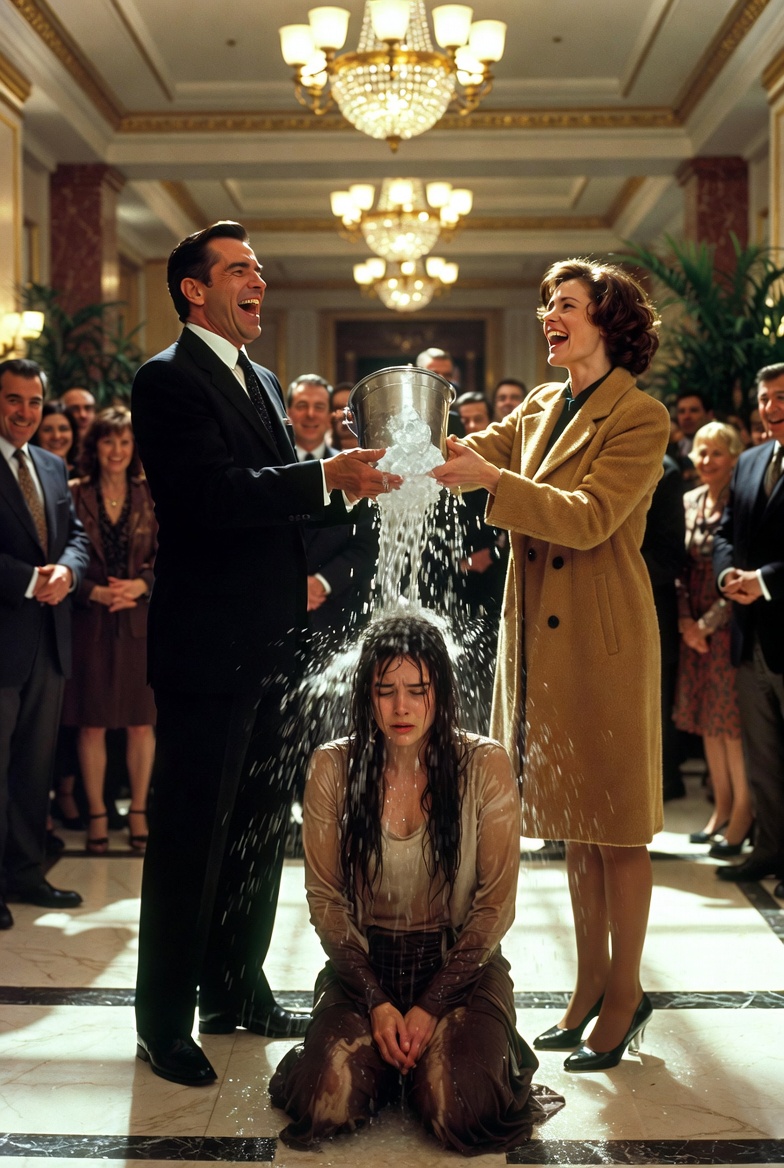
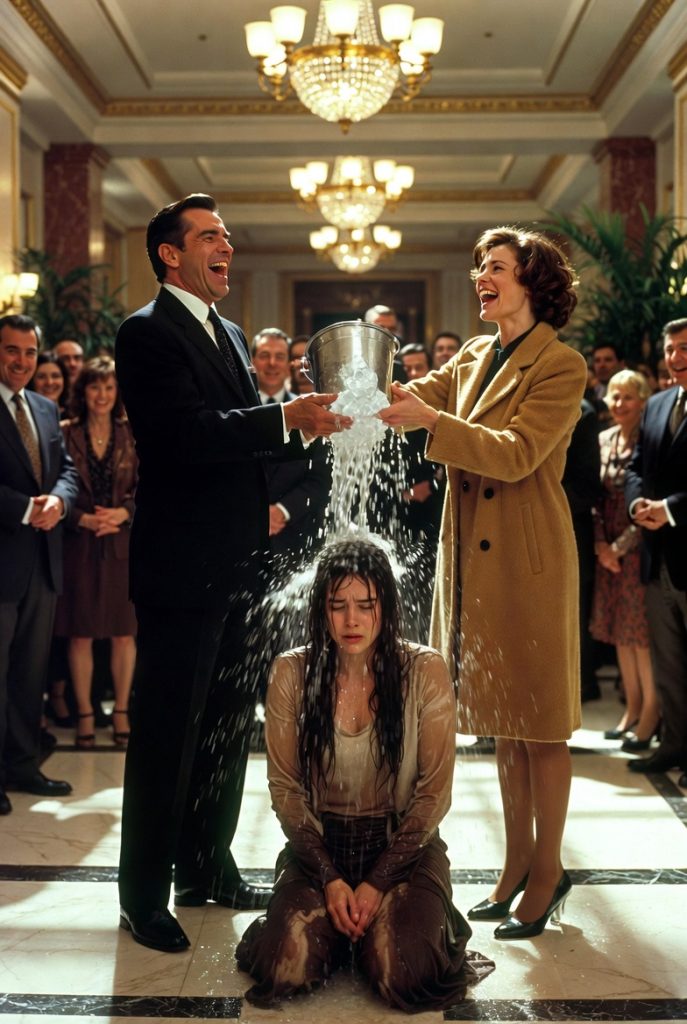
Laurent took the silver bucket from the bartender’s hands. The ice cubes clinked cheerfully. He approached slowly, like an actor who knows every camera is on him. Claire stood slightly behind, one gloved hand over her mouth, eyes sparkling with excitement.
“You know, little one,” he began in a loud voice so the entire lobby could hear, “we don’t really like parasites here. They ruin the Instagram shots.”
He tilted the bucket.
The ice water fell first in a thin stream, then in a heavy cascade. Ice cubes struck Émilie’s skull with small, sharp impacts. Water ran over her forehead, into her eyes, into her mouth, soaked her sweater, her jeans, her already-holed shoes. The cold was so violent she thought her heart would stop. But she did not move. Not a flinch. Not a cry. She remained seated, back straight, chin down, shoulders motionless—like a statue being desecrated.
Claire burst into laughter, a crystalline, almost musical sound. Laurent joined her, deeper, more satisfied. Around them the crowd took up the chorus: coarse laughs, discreet applause, phones coming out to capture “the viral moment.”
“Look at her! She doesn’t even flinch!” exclaimed a woman in a red dress.
“Homeless stoicism, I swear!” snickered a banker.
The water kept pouring. Émilie’s hair dripped in long strands. A puddle formed around her, reflecting the chandeliers like a shattered mirror.
The bucket emptied. Laurent let it drop beside her with a metallic clang that echoed through the entire lobby. He wiped his hands on a silk handkerchief as though he had touched something filthy.
Émilie stayed perfectly still for another five seconds. Ten. Fifteen.
Then, very slowly, she raised her head.
Her eyes were red, but not with weak tears. With rage held inside for years. Ice water still streamed down her face, yet her gaze burned. It pierced Laurent Beaumont like a white-hot blade. In her pupils one could read an entire life: her father’s death at fifty-two, her mother’s untreated cancer, the bailiffs, nights in shelters, job rejections the moment they saw her suburban address.
And above all, certainty.
Claire stopped laughing first. Something in that stare unnerved her. Laurent frowned, irritated.
“What? You want a picture?” he threw out, trying to hide his unease.
Émilie finally spoke. Her voice was low, hoarse, but every word carried weight.
“Mr. Beaumont… you don’t recognize me.”
Silence fell over the lobby. Even the chandeliers seemed to hold back their light.
“I’m Émilie Moreau. Paul Moreau’s daughter. The man whose forty percent of this hotel you stole in 2012 with fake balance sheets and a judge you paid with Deauville weekends.”
Laurent went pale. Claire clutched her pearl necklace as though she were choking.
Émilie rose slowly. Water still dripped from her clothes, but she stood straight—taller than her actual height. She pulled the yellowed letter, the property deed, and the photograph from her backpack.
“I spent eleven years gathering these. I slept in squats. I ate supermarket trash leftovers. And tonight I came to take back what belongs to my family.”
She held the documents out toward him. Her hand did not tremble.
“You can keep your ice bucket. But tomorrow morning at nine o’clock my lawyer will be here—with the press, financial police, and every shareholder you ever betrayed.”
She took one step forward. Water from the puddle splashed onto Laurent’s thousand-euro shoes.
“And the next time you want to humiliate someone… look closer into their eyes. You never know who you’re drowning.”
She walked past them. No one dared stop her. Phones were still recording, but the laughter had died. Faces were ashen. Claire stepped back as though Émilie were contagious.
Just as she reached the revolving door, Émilie turned one last time. The ice water had dried on her cheeks, but her eyes still burned.
“Thank you for the cold shower, Mr. Beaumont. It woke me up.”
The door spun behind her.
In the lobby the silence was so heavy that only the drip-drip of the last melting ice cubes on the marble could be heard.
Laurent Beaumont stood frozen, arms limp, his suit suddenly too big for him. For the first time in many years, he had nothing to say.
Outside, under the fine February rain, Émilie walked toward the metro station. She was still shaking, but no longer from fear.
It was victory.
And somewhere deep in her memory, she heard her father’s voice repeating what he used to tell her when she was small and fell down:
“Get up, sweetheart. Cold water passes. What remains is you.”
She smiled into the night.
For the first time in eleven years, she was no longer cold.