
The Dance of Shadows
The Dance of Shadows
Aaliyah had not come to Oregon to die.
She had come for three days of silence—real silence, the kind that presses against your eardrums and makes you remember what your own heartbeat sounds like. No agents. No red carpets. No flashing cameras asking her to smile wider, look younger, sound grateful. Just a rented cabin on the edge of the Siuslaw National Forest, a bottle of pinot noir, a notebook, and the hope that she could write one honest sentence before the world demanded another performance.
She left the cabin at dusk on the second night.
The air was cool and thick with the smell of Douglas fir and damp earth. She wore a simple black silk dress—sleeveless, fitted at the waist, the hem brushing mid-thigh. It had been a last-minute choice: elegant enough to feel like herself, light enough to walk in. She carried only a small crossbody bag with her phone, a flashlight, and a half-charged power bank. She told herself she would follow the marked trail for an hour, no more, then turn back.
She never made it to the first marker.
The first whistle came when she was perhaps a kilometer from the cabin.
Sharp. High. Human.
It sliced through the forest like a thrown knife.
She stopped.
A second whistle answered from her left—lower, amused.
A third from somewhere behind her—closer than the first two.
Aaliyah’s pulse jumped into her throat.
She did not run immediately. Running would confirm she was prey. Instead she turned slowly, scanning the trees. The forest was already dark under the canopy; twilight had bled into full night without her noticing. The only light came from the thin silver of a crescent moon filtering through the branches.
Another whistle—now from the right.
They were surrounding her.
She started walking again—fast, but not panicked. She kept her steps measured, heels sinking into the soft needle carpet. The dress caught on ferns and low branches; she tore it free without stopping.
The whistles became a pattern: one short, one long, one short. A code. A game.
She understood then.
They were not chasing to catch.
They were chasing to watch her break.
Aaliyah had spent her entire adult life performing under pressure—red carpets, live television, hostile interviewers. She knew how to smile when she wanted to scream. She knew how to keep her breathing even when her heart wanted to explode.
But this was different.
This was not a stage.
This was a hunt.
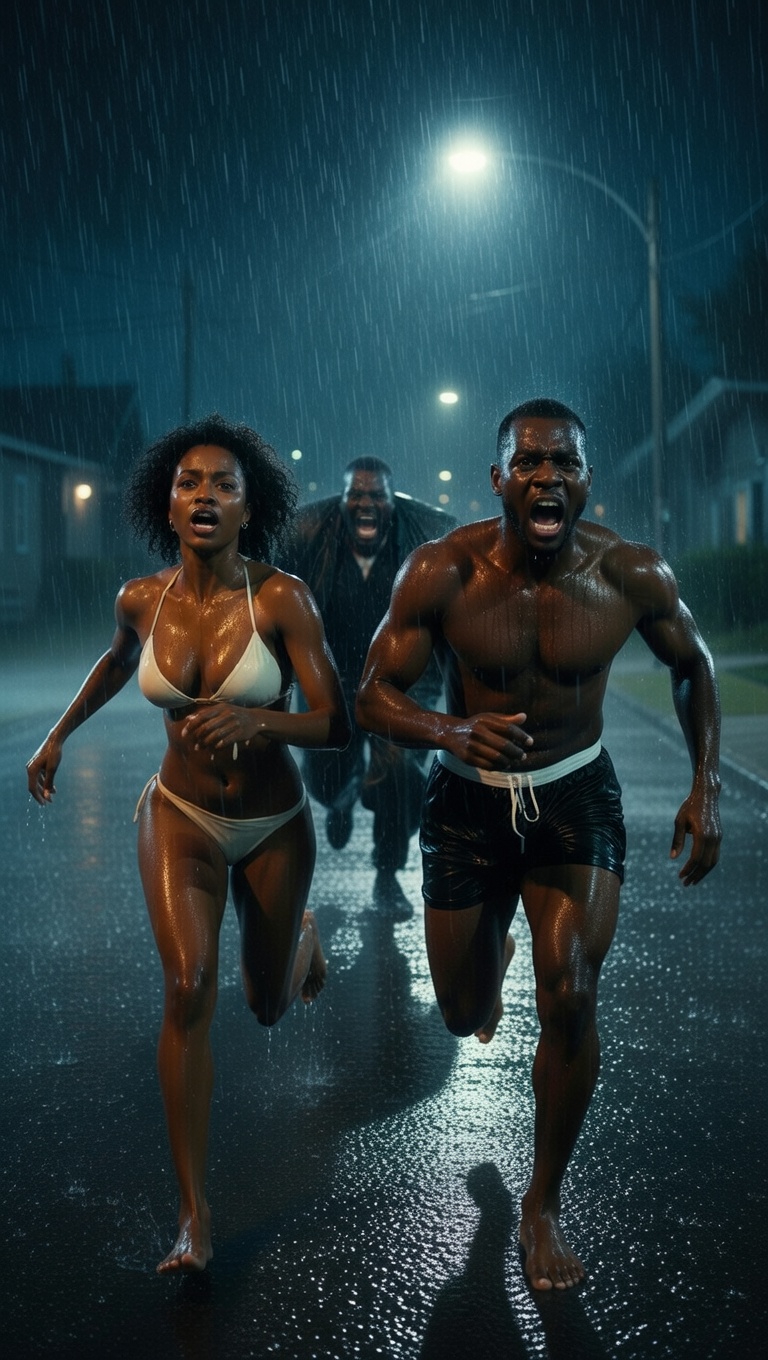
She broke into a run.
The whistles turned into laughter—low, male, scattered through the trees like echoes.
She ran harder.
The dress ripped at the thigh. Her heels snapped off one after the other; she kicked them away and kept going barefoot. Pine needles stabbed her soles. Branches clawed at her arms, her face. Blood trickled into her left eye.
She burst into a small clearing.
Moonlight poured down like spilled milk.
No road.
No trail.
Just a circle of old-growth cedars and, in the center, a single rusted metal stake driven into the ground—perhaps the remnant of an old survey marker.
She stopped.
Panting.
Listening.
Silence.
Then footsteps—slow, deliberate, three sets converging from different directions.
They stepped into the moonlight one by one.
Three men.
All in their late twenties, early thirties. Expensive hiking gear—Arc’teryx jackets, Salomon trail runners, headlamps turned off. They carried nothing but confidence and cruelty.
The tallest one—the one with the shaved sides and the neck tattoo of a coiled snake—spoke first.
“You run pretty good for a city girl.”
The second—stocky, blond buzzcut—laughed.
“We were gonna let you get farther,” he said. “Make it more fun.”
The third—lean, dark-haired, the quietest—said nothing. He just watched her with the flat, empty eyes of someone who had done this before.
Aaliyah straightened.
Her dress was torn, blood streaked across her cheek, feet bleeding. But she stood tall.
“You made a mistake,” she said.
The tall one laughed.
“Oh yeah? What’s that?”
“You thought I was alone.”
She reached into her crossbody bag.
Pulled out her phone.
Held it up.
The screen glowed—recording.
Live stream.
The red dot blinked steadily.
She had started it the moment she heard the first whistle.
And she had angled the camera perfectly—her face in frame, the clearing visible, their faces now lit by the screen’s glow.
The tall one’s smile vanished.
“You’re live?” he asked, voice suddenly thin.
“Fifty-seven thousand viewers,” she said. “And climbing.”
She turned the phone slowly, letting the camera sweep across each man’s face.
“Say hi to the world,” she told them.
The blond one stepped forward.
“Give me the fucking phone.”
Aaliyah backed up one step.
“Touch me,” she said, “and every single person watching will know exactly who you are.”
The quiet one—the one with the dead eyes—finally spoke.
“She’s bluffing.”
Aaliyah tilted the phone so the camera caught his face clearly.
“Am I?”
She tapped the screen.
The live chat exploded.
WTF is happening? Call the police! Those faces—I know that guy from Eugene! This is real? Holy shit.
The tall one lunged.
Aaliyah sidestepped—smooth, practiced—and drove her elbow into his solar plexus. He doubled over, gasping.
She didn’t stop.
She kicked the blond one in the knee—hard, precise—and he dropped with a yelp.
The quiet one hesitated.
Aaliyah raised the phone again.
“Still live,” she said. “Still recording. Still every second of your faces.”
Sirens wailed in the distance—faint, but growing.
Someone in the chat had already called 911. Coordinates shared. Location triangulated from the phone’s GPS.
The quiet one looked at his friends.
Then at her.
He raised both hands slowly.
“We were just messing around,” he said.
Aaliyah didn’t answer.
She kept the camera steady.
The sirens grew louder.
Headlights flashed through the trees.
The three men looked at each other.
Then they ran.
Aaliyah didn’t chase.
She stood in the clearing, phone still raised, rain dripping from her hair, blood drying on her cheek.
The live stream hit 1.2 million viewers.
By morning the video had been downloaded, mirrored, shared across every platform.
By noon the three men had been identified—sons of wealthy Portland families, known for drunk driving incidents they had always bought their way out of.
By evening they were in custody.
Aaliyah gave one interview—short, composed, voice steady.
“They thought I was prey,” she said.
She looked straight into the camera.
“They were wrong.”
She ended the call.
Then she walked back to the cabin.
She showered.
She bandaged her feet.
She sat on the porch with a fresh glass of rosé and watched the sun rise over the forest.
The world had seen her.
Not as a victim.
Not as a headline.
As a woman who had refused to be erased.
And somewhere in the quiet of that moment, the silence she had come to find finally arrived.
Not empty.
But hers.


About The Author